Grilling Salmon Steaks and Fillets | Grilling a Whole SalmonGrilling Tips | Food and Grill Safety
Salmon is an anadromous fish, which means that it is born in freshwater, then migrates to saltwater to mature and then returns to freshwater to spawn. It is a popular fish to serve, providing a tender, flaky textured meat with a mild to rich flavor, depending on the species. It is a fish that is rich in omega-3 fatty acids, which help to reduce LDL (bad) cholesterol. Salmon can be prepared in most any manner, such as smoked, baked, broiled, grilled, fried, or poached. Salmon originated in the Atlantic and Pacific Oceans but are now grown in most locations where there is cold, protected seawater.
Grilling Salmon Steaks and Fillets
Buying Hints
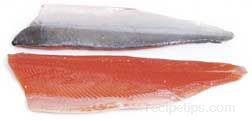
Fresh salmon steaks and fillets should be firm and deep, "salmon pink" in color. The meat should have a slight sheen and appear somewhat translucent. Choose steaks and fillets with smooth cuts. Cuts of salmon that have gaps or separation of muscle fibers are indicative of old fish.
- Packaged salmon should be stored in an airtight container with no visible liquid.
- Frozen salmon should be in an air tight package with no visible frost.
- Refrain from purchasing salmon that has a strong "fishy" smell - the fish odor should be mild.
Preparation
- Keep salmon refrigerated until ready to grill.
- Keep salmon skin intact while grilling. The skin will prevent the salmon from curling up and flaking apart. The skin is easily removed after grilling.
- Brush salmon and grill grate with a thin coat of cooking oil to prevent sticking on the grill. Oil the grill grate before starting the grill.
Grilling Method
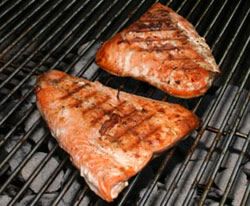
Use the indirect grilling method with a medium hot grill.
- Grill fish 3-4-inches from heat.
- Place salmon steak/fillet skin side up directly on the grill grate.
- Grill the steaks/fillets for a total of 4-6 minutes (2-3 minutes per side) per 1/2-inch thickness, turning only once.
Check for Doneness
Salmon continues to cook after being removed from the grill. Cook salmon until the meat begins to change color and becomes flaky. To check the flakiness, insert the tip of a sharp knife near the bone or at the thickest part of the salmon and pull slightly. Well done salmon appears opaque and will flake easily.
Grilling a Whole Salmon
Buying Hints
- Fresh, whole salmon should appear firm, have glossy skin, and clear (rather than cloudy) eyes.
- The gills should be bright red and the flesh a light pink and somewhat translucent.
- Whole salmon needs to be completely packed in ice.
- Refrain from purchasing salmon that has a strong "fishy" smell - the fish odor should be mild.
Preparation
- Store the salmon on ice or in the refrigerator until ready to cook.
- Rinse the salmon inside and out under cool water to remove any stray scales or bones.
- Pat the salmon dry with paper towels.
- The body cavity of the fish can be filled with fresh herbs and lemon slices if desired.
- Close the body cavity of the fish and tie with butchers twine.
- Score 3 diagonal cuts on both sides of the fish.
- Brush the whole fish (including the head) and the grill grate with a thin coat of cooking oil to prevent the salmon from sticking. Oil the grill grate before starting the grill.
- If using a grill basket, oil the basket as well.
Grilling Method
Use the indirect grilling method.
- With a high heat setting, heat the grill and then turn down the heat to medium before placing whole fish on the grill.
- Grill the fish 3-4 inches from heat, 20 to 25 minutes (10-12+ minutes per side) per 1/2 pound.
- Turn the whole salmon only once during cooking.
Check for Doneness
Salmon continues to cook for 1-2 minutes after being removed from the grill. Cook the salmon until meat begins to change color and becomes flaky. To check the flakiness, insert the tip of a sharp knife near the bone or at the thickest part of the salmon and pull slightly. Well done salmon appears opaque and will flake easily.
Grilling Tips

Using the following tips will ensure success when grilling salmon.
- Thin cuts of salmon tend to dry out quicker than thick cuts.
- Sprinkling the salmon with salt 2-3 minutes before grilling will help draw out the natural juices.
- Aspic, cucumber, lemon, dill, and fennel is a classic combination used to fill the cavity of a whole salmon before cooking.
- Apply basting sauces during the final few minutes of cooking to prevent the salmon from turning black.
- Leave the skin of salmon intact to hold the flesh together during grilling.
Food and Grilling Safety
- Oil grates with nonstick spray (or brush oil on grates) before starting grill to prevent a fire from erupting.
- Always wash hands with soap and water before and after handling raw and cooked salmon.
- All surface areas that have been used in the preparation of raw salmon should be sanitized. Do not allow any non-sanitized surface to come in contact with cooked salmon.
- Eating raw or undercooked salmon can be dangerous, grill until the salmon becomes opaque (raw salmon is translucent).
- If salmon will not be prepared immediately after purchase, salmon should be stored in the coldest area of your refrigerator where it can be kept for 1 to 2 days. It is safest to grill the salmon immediately after purchase.
- Serve salmon immediately after removing from the grill. If there are leftovers, refrigerate within 1 hour. Eat refrigerated leftovers within 1 to 2 days.
- Do not allow contact of raw salmon with cooked salmon.
- Signs of spoiled salmon may include strong odor and color changes. If uncertain, discard the salmon.