|
Grilling Methods | Grilling Times | Checking Doneness | Grilling Tips
The grilling process cooks foods over a heat source, either directly, indirectly, or a combination of both. Grilling temperatures typically reach as high as 650ºF, but any temperature above 300°F is suitable as a grilling temperature. The high heat of grilling sears the surface of fish, creating meat with a flavorful crust. The required cooking temperature and the method of grilling (direct, indirect, or a combination) depends on the size of the fish or the pieces. It is important to cook the fish to its proper doneness but not to overcook.
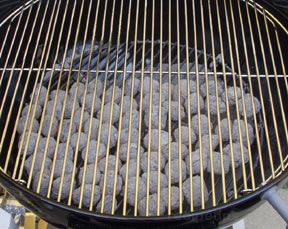
There are many different types of grills available today that can be used when grilling fish. For information on the different types of grills, see Types of Grills. It is important that the grill is set up properly and reaches the appropriate temperature for the type of fish that is being grilled to ensure that it produces a moist and flaky finished product that is cooked to the proper doneness. For information on setting up a charcoal or gas grill, see Outdoor Grill Preparation.
A medium heat should be used when grilling fish, whole or pieces. Using too high of a heat will cause some parts to cook too quickly and dry out while other parts will not be done all the way through. To check the temperature of the grill, use the palm of your hand for testing, see Outdoor Grill Preparation for testing method. The thicker the piece of fish the farther away from the heat source it should be or the heat source should be at a lower temperature to prevent the outside of the cut from burning before the inside is properly cooked. You will also have to decide whether you will use direct or indirect heat during the grilling time. Depending on the type of fish and size, you may use both. A whole fish or a thick piece may require direct heat to seal the outside and indirect to allow the cut to cook thoroughly to the center.
Grilling Methods
Indirect Heat | Direct Heat
Indirect Heat
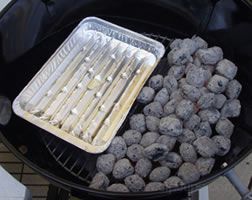
Cooking with indirect heat occurs when you use an area of the grill that is not directly over the heat source. Using indirect heat slows the cooking process down, which allows the center of the fish to cook thoroughly without burning the outside. On charcoal grills, coals are pushed to one side of the grill or banked into a ring around the outer edges. On gas grills, the side of the burner, which is below the area where the food will be placed, is turned off after the grill is preheated. Using one of the indirect setups will provide an area on the grill that is a low heat source. The fish is placed over the area in which there are no coals or over the burner that is turned off on a gas grill. Indirect heat is good for cooking whole fish or larger pieces.
To prepare the grill for indirect heat, see Methods of Grilling for setup.
See general instructions below for cooking fish using indirect heat.
|
Preparation
- Keep the fish refrigerated until ready to grill.
- If skin has not been removed, keep it intact while grilling. The skin will prevent the fish from curling up and flaking apart. The skin is easily removed after grilling.
- Rinse the fish thoroughly and pat dry with paper towels.
- If preparing a whole fish, rinse the fish inside and out. Pat dry with paper towels and stitch cavity shut with butcher's twine. Cut 3 diagonal slits on each side of the fish.
- Brush the fish and grill grate with a thin coat of cooking oil to prevent sticking on the grill. Oil the grill grate before starting the grill.
- If a grill basket is used to hold the fish, be sure to oil that also.
|
|
Cooking
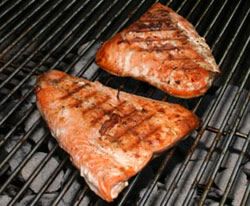
Use the indirect grilling method with a medium hot grill when cooking whole fish and thick fillets or steaks. |
- Place the fish skin side up on the grill grate over indirect heat area. Do not place directly over the heat source.
- Cook the fish for 10 minutes per inch of thickness. Turn to grill on the other side for approximately half way through time.
- Insert the tip of a knife in thickest area of the fish to check for doneness. The meat should be flakey and opaque in appearance. The internal temperature of the fish should be at least 145°F.
|
|
 |
Direct Heat:
Cooking with direct heat occurs when you cook the meat directly over the heat source. The fish is cooked quickly over medium or high heat coals or over burners set to medium or high heat on a gas grill. Direct heat is used when grilling thinner fillets and steaks. Thin fish will cook quickly when grilled using direct heat. Because they are thin, the direct heat will cook them thoroughly through to the middle.
For more detailed setup information on grilling, using direct heat, see Methods of Grilling.
|
Preparation
- Keep the fish refrigerated until ready to grill.
- If skin has not been removed, keep it intact while grilling. The skin will prevent the fish from curling up and flaking apart. The skin is easily removed after grilling.
- Rinse the fish thoroughly and pat dry with paper towels.
- Brush the fish and grill grate with a thin coat of cooking oil to prevent sticking on the grill. Oil the grill grate before starting the grill.
- If a grill basket is used to hold the fish, be sure to oil that also.
|
|
Cooking
Use the direct grilling method with a medium hot grill when cooking thinner fillets and pieces of fish.
- Place the fish skin side up on the grill grate over the direct heat source.
- Cook the fish for 4 to 6 minutes and then turn to grill on the other side for approximately same amount of time.
- Insert the tip of a knife in thickest area of the fish to check for doneness. The meat should be flakey and opaque in appearance. The internal temperature of the fish should be at least 145°F.
|
Fish Grilling Times
Fish cooking temperatures are important to monitor in order to insure meat is safely cooked to the proper temperature. When preparing fish, use the chart below as a guide to check doneness.
| FISH Grilling Temperatures and Times |
| |
Approximate Cooking Time |
| Portion |
Temp. |
Weight /
Thickness |
Total Time |
| Grilled - 4 in. from the Heat Source |
Turn Once |
| Whole |
Med |
 |
10-20 min |
| Fillets |
Med |
.75 in. |
7-9 min |
| Steaks |
Med |
1 in. |
9-10 min |
| Note: Cooking times are estimated times and will vary depending on the type and thickness of the fish. Fish is done when meat turns opaque white and has a flakey texture. Overcooking will cause the fish to be tough and lose flavor and moisture. |
Checking Doneness
There are several methods that can be used to check for the doneness of fish. Some methods work better on some types of fish than others. Similar to meat, fish continues to cook after removing it from the heat. So for a more flavorful result, begin checking for doneness a few minutes before the end of the estimated cooking time. Since the meat of the fish is somewhat translucent, it begins to become opaque as it cooks, which is one method of visually checking for doneness, especially for fillets that are most often not as thick as fish steaks.
The best procedure for checking doneness is to use a cooking thermometer, checking to make sure the fish has reached an internal temperature of 145ºF. To cook fish steaks that are slightly translucent in the center, remove the steaks from the heat when they reach an internal temperature of 135ºF to 140ºF. The fish steaks will continue cooking with the retained heat if they are covered and left to stand a few minutes prior to serving.
Listed below are other methods that can be used to check for doneness.
- To check the fish for doneness, use the tip of a sharp knife and cut through the thickest part of the fillet. If the fish has been properly cooked, the meat will appear opaque but will still be moist. Some varieties of fish contain more fat, such as salmon or tuna, which can be cooked until opaque on the outside while remaining somewhat translucent on the inside.
- Another test to use for doneness is to check the meat with a knife to see if it is firm and beginning to separate or "flake". If the fish flakes too easily, it may be overcooked. The meat should slightly resist separating, but still be able to be separated, thus indicating it is moist and not too dry.
- When cooking fish that has not been boned, such as trout or pan fish, the meat should not drop off the bones, but instead should slightly resist removal.
Grilling Tips:
- Rub lemon juice on fish before cooking. This will help the fish maintain its color and add to its flavor. Also, brush the fish with lemon juice while grilling to help keep it moist.
- Wrapping fish in foil also keeps it moist and prevents sticking. Spray the inside of the foil with non-stick cooking spray to prevent sticking.
- Fish that is less than 1/2 inch thick do not require turning when cooking.
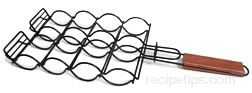
- A grill basket makes grilling fish, especially smaller pieces, considerably easier when cooking it and when it comes time to clean-up. Be sure to spray or brush the basket with oil to prevent sticking.
- Increase cooking time when cooking fish that is frozen.
|