|
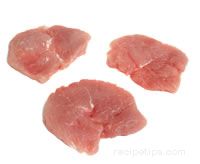
Pork is the meat from the carcass of a pig. The carcass is generally split into two sides of pork, each consisting of four primal cuts. Each primal consists of subprimal cuts that are divided into several specific market ready cuts. Even though pork is generally white in color, when cooked it is still considered "red meat" because it contains higher levels of a protein called myoglobin than chicken or fish. The amount of myoglobin contained in meat is what determines its color. Like beef, lamb and veal, pork is also classified as "livestock" and all livestock is categorized as "red meat." Pigs today are raised much leaner than they were years ago, now containing 35% to 50% less fat. The primal cuts, with their subprimal and market ready cuts are shown below.
|
Primal Cut - Shoulder
The shoulder is the primal cut that includes the front leg and the section at the top of the leg. It contains a higher level of fat than the other cuts of pork, which provides it with a lot of flavor and tenderness, but also causes the cuts from this area to add more fat into our diets than the meat from some of the other primal cuts. The fat content in the shoulder makes this cut desirable for making sausage and when well-trimmed, it is used for lean ground pork and is also cubed or cut into strips to use for kabobs, stir-frying or stewing. The shoulder is one of the most flavorful and economical cuts. |
| Subprimal Cut |
Market Ready Cuts |
Description |
| Blade (or Butt) Shoulder |
Blade Boston Roast,
Smoked Shoulder Roll,
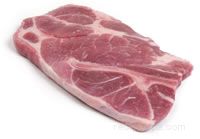
Blade Steaks,
Cubes |
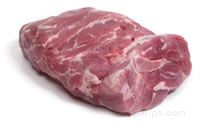
The blade shoulder subprimal is a better cut than the picnic. The blade is the upper portion of the shoulder and is tender and full of flavor. The roasts from this cut are available bone-in or boneless and are best cooked using a moist heat method, such as braising or stewing, but they can also be roasted. The steaks, which are cut from the blade Boston roasts, are best broiled, grilled or braised. |
| Picnic (or Arm) Shoulder |
Picnic Roast,
Arm Steaks,
Picnic Ham,
Shanks (Hocks),
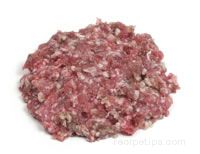
Ground Pork |
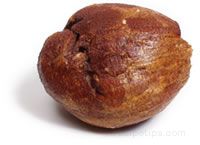
The picnic shoulder is more economical but also contains more fat than the blade shoulder. When the bone and fat is trimmed from this cut it results in a very rich flavored roast. The meat from this cut is excellent for making juicy barbecued pulled pork. Many times the picnic shoulder is cured and smoked to make a picnic ham, which is ready to eat when purchased or can be heated before eating if desired. If not cured and smoked, they can be roasted, baked, braised, or simmered. The fresh meat from this cut is best cooked by methods such as roasting, braising or stewing. Steaks are especially good tasting when grilled. |
|
Primal Cut - Loin
The loin is located on both sides of the backbone starting at the shoulder and continuing back to the hind leg. It is the largest, most tender and leanest cut from the pig. Some of the cuts from this primal cut demand the most in price because of their quality. It is important to be careful not to overcook some of these cuts because they will dry out easily due to their leanness. The cuts from the loin are available both with bone-in and boneless. Cubes and strips are also available for kabobs, stir-frying or stewing. |
| Subprimal Cut |
Market Ready Cuts |
Description |
| Rib or Blade End |
Rib End (or Blade Loin) Roast,
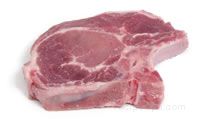
Blade Chop,
Rib Chop,
Back Ribs,
Country-Style Ribs |
The rib end is the section of the loin that is the closest to the shoulder. It contains more fat than the center cut or sirloin end of the loin. Cuts from the rib end, such as chops, can be cooked by dry heat methods, which would be pan-frying, sautéing, grilling, and broiling, or they can be braised or barbecued. Roasts from the rib end of the loin are generally cooked by roasting or braising, but can also be grilled if not placed directly over the heat source. Ribs are generally roasted, baked, barbecued, or braised. |
| Center Cut |
Center Loin Roast, Crown Roast,
Top Loin Roast,
Rack of Pork,
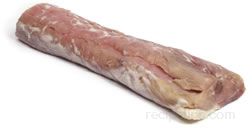
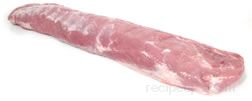
Tenderloin,
Steaks,
Center Cut Chops,
Loin Chops,
Back Ribs,
Canadian-Style Bacon |
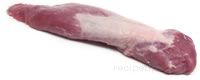
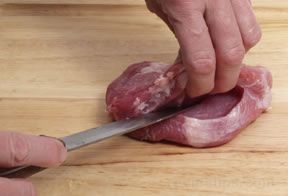
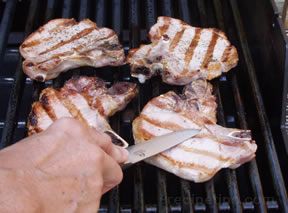
The center cut is the middle section of the loin. It contains the most tender and lean cuts from the loin, which are generally the more expensive cuts on the pig. Chops and steaks are often cooked using methods such as grilling, broiling, pan-frying, sautéing, or braising. Roasts from the loin are generally cooked by roasting or braising, but can also be grilled if not placed directly over the heat source. The crown roast is cooked by roasting and can be stuffed before cooking. Ribs are generally roasted or barbecued. The tenderloin is a narrow muscle that runs along the bottom edge of the loin, starting approximately in the middle and extending back to the leg. It is a very tender, lean, and boneless cut, which can be roasted, braised, pan-fried, grilled, or broiled but must not be overcooked. It is sometimes cut into smaller pieces, such as cutlets, medallions and scallops, before cooking. The tenderloin is not always removed as a separate cut and may be cut so that sections are left in the chops or roasts. Canadian-Style bacon is smoked and available ready to eat. It can also be heated before eating or it can be added to other dishes. |
| Sirloin |
Sirloin Roast, Tenderloin,
Steaks,
Sirloin Chops,
Sirloin Cutlets,
Button Ribs |
The sirloin is the section of the loin closest to the rump of the pig. This section contains more bone in comparison to meat than the other loin sections. Chops, cutlets and steaks are generally cooked using methods such as grilling, broiling, pan-frying, sautéing, or braising. Roasts from the loin are most often cooked by roasting or braising, but can also be grilled if not placed directly over the heat source. Button ribs are generally roasted or braised. The tenderloin, which is a very tender, lean and boneless cut, can be roasted, braised, pan-fried, grilled, or broiled but must not be overcooked. It is sometimes cut into smaller pieces, such as cutlets, medallions and scallops, before cooking. |
|
Primal Cut - Leg/Ham
The leg is a primal cut that is located at the rear of the pig and is made up of the rump and hind leg. The meat from the leg is lean and flavorful but is not as tender as the meat from the loin. Generally the cuts from the leg are more economical than those of the loin. Most cuts from the leg are available bone-in or boneless and can be found fresh but are generally cured and smoked. The leg is sold whole, in halves or in smaller cuts. Cubes and strips are also available for kabobs, stir-frying or stewing. |
| Subprimal Cut |
Market Ready Cuts |
Description |
| Butt Half (or End) |
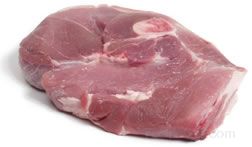
Fresh Ham Roast,
Ham,
Fresh Ham Steak,
Center Ham Slice |
The butt half of the leg is the portion located on the upper part of the leg in the rump area. It is meatier than the shank half but the bone-in roasts and hams are harder to carve because they contains the hip and pelvic bone. The roasts from this section are generally roasted, but can benefit from moist heat methods such as braising. If cured and smoked, hams are ready to eat when purchased or they can be heated if desired, otherwise they can be roasted, baked, braised, or simmered. The ham steaks and center ham slice, which is cut from the center of the leg, are delicious when grilled or broiled, but because they can be a little tough it is beneficial to marinate them first. They can also be braised, pan-fried or cut into strips and used for stir-frying. |
| Shank Half (or End) |
Fresh Ham Roast, Ham,
Fresh Ham Steak, Shanks (or Hocks) |
The shank half of the leg is the bottom portion of the leg and includes the shank. It contains only one leg bone, making it easier to carve. The roasts from this section are generally roasted, but can benefit from moist heat methods such as braising. If cured and smoked, hams are ready to eat when purchased or they can be heated if desired, before eating. Otherwise they can be roasted, baked, braised, or simmered. The steaks are delicious when grilled or broiled, but because they can be a little tough it is beneficial to marinate them first. They can also be braised, pan-fried or cut into strips and used for stir-frying. |
|
Primal Cut - Side/Belly
The side/belly is the primal cut that is located on the lower part of the pigs body, directly below the loin. The cuts from this area are very flavorful but they also contain a fair amount of fat. |
| Subprimal Cut |
Market Ready Cuts |
Description |
| Side Rib |
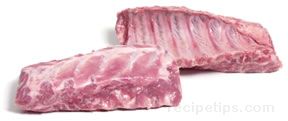
Spareribs,
Brisket Bone,
St. Louis Style Ribs |
The side rib contains the spareribs, which is the rib section of the side/belly. They contain at least eleven rib bones. St. Louis Style ribs are spareribs with the brisket bone removed. The brisket bone is the meaty section located at the bottom of the spareribs, which is cut off to produce St. Louis Style ribs. Ribs can be cooked by broiling, grilling, braising, or by first braising the ribs and then finish cooking by barbecuing. |
| Side Pork |
Side Pork,
Bacon,
Salt Pork |
The side pork is the section of the side/belly that is left after the spareribs are removed. It produces side pork, bacon and salt pork. Side pork is not cured or smoked, bacon is both cured and smoked, and salt pork is cured but sold fresh. All are available in a bulk slab or pre-sliced. The cuts from the side pork are generally pan-fried or broiled but can also be roasted in the oven, cooked in the microwave or simmered in water. |
|
Specialty Cuts
Generally Special Order Items |
| |
Market Ready Cuts |
Description |
| Specialty Cuts |
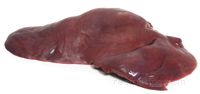
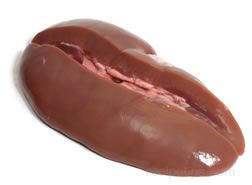
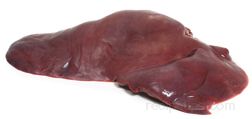
Trimmings, Liver, Heart, Kidneys, Tongue, Pig's Feet (or Trotters), Pig's Head, Pig's Tail, Pork Jowls |
The trimmings from different cuts of the pig are widely used for making products such as ground pork, cubed pork and sausage. Although some of the other specialty cuts are sought in other societies, consumers in the United States are reluctant to accept them, resulting in these cuts being available on a limited basis. |
Some pork is raised under organic and natural standards. To qualify under these classifications, specific guidelines must be followed. The guidelines for organic and natural standards are shown below.
Natural
Pork can be labeled as "natural" if it complies with the USDA standards for natural processing, handling and labeling. The standards stipulate that the product cannot contain artificial ingredients, artificial coloring, or chemical preservatives, and can only have minimal meat processing done. It can be processed using traditional methods to preserve it and to make it edible and safe to consume. Methods such as freezing, smoking, roasting, drying, and fermenting can be used. Physical processes, such as cutting into component retail cuts, are allowed but processes, such as grinding, which alter the raw product, are not allowed. Products labeled "natural" should include a statement explaining the term.
When producing "natural" pork, the pork producers must follow the production guidelines set up by the FDA for all federally inspected pork. It is the pork processor and handler who must comply with the USDA standards for natural processing, handling and labeling.
Organic
Pork labeled "organic" must be produced and processed according to the specifications established in the USDA's Organic Standards. The standards prohibit synthetic input in all processes of pork production and meat processing and handling. Producers and processors must receive certification from a government-approved inspector.
The pork producer must comply with the USDA production specifications. The guidelines prevent synthetic input in regard to livestock sources, housing conditions, waste management, health care of livestock, water, feed, and slaughter processes. Any genetic engineering, antibiotics or vaccines, feed supplements or additives, and fertilizers that are used must be in accordance with the USDA's list of allowable substances.
The meat processor and handler must comply with organic processing, handling and labeling standards set up by the USDA. The standards state that the product must be kept in its purest form by eliminating the use of artificial ingredients, additives, preservatives, and irradiation. Only minimal meat processing is allowed and meat must be packaged and stored in containers that do not contain preservatives, fumigants or synthetic fungicides. The product must also be labeled with the proper identification.
Organic pork must be labeled in compliance with the standards set by the USDA. The USDA organic seal is only applied to products that are "100% organic", which means they have been produced exclusively according to the USDA organic regulations and on products that are labeled "organic", meaning they have been produced 95% organically with the other 5% being in compliance with the National List of Synthetic and Prohibited Non-Synthetic Substances. Other organic labeling that you may see is "Made with organic" if 70% to 95% of the product has been organically produced and "X% organic" ("X%" being a percentage less than 70%) can be indicated on the information panel if the product is less than 70% organically produced. The presence of the USDA organic seal does not indicate a nutritional or safety statement about the product, it only indicates that the product has been at least 95% organically raised.
"Natural or organic" pork is prepared and cooked using the same methods that are used on other pork. The consumer sees "natural or organic" pork as being more nutritious and better for the environment but there is no scientific evidence to support the perception, that "natural or organic" pork is better in quality, appearance or environmentally, than traditionally produced pork. |