|
When working with chicken it is essential that proper handling and storage is used to ensure safety. You cannot see the harmful bacteria on the chicken so you must handle it as if it is present. Salmonella is a bacteria that can cause foodborne illness and is sometimes found on chicken. Follow the guidelines below to ensure safety against foodborne illnesses when handling chicken.
Contamination Prevention
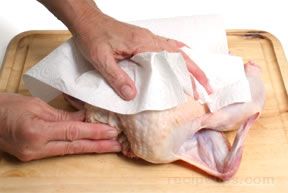
Cleanliness: A clean working environment is essential in the prevention of contamination when working with chicken. Be sure to wash hands thoroughly before and after handling raw chicken. The work area, cutting boards, and utensils must be thoroughly cleaned with hot soapy water after being exposed and should not be used for other foods until properly cleaned. This will prevent cross contamination of bacteria from the chicken to other foods.
When working with other foods at the same time as preparing and cooking chicken, be sure to use different utensils for each food. Do not use the same cutting board to carve cooked chicken as was used for the raw meat, unless it has been properly washed and dried before using. Cutting boards should be thoroughly scrubbed with hot soapy water after each use and periodically cleaned with a bleach solution consisting of 1 tablespoon of bleach per gallon of water.
Handling: Raw chicken should be purchased just before checking out at the store so it is exposed to unsafe temperatures for as short a time as possible. It should be placed in a plastic bag to prevent any leakage from contaminating any other foods. After purchasing it should be taken home and refrigerated as soon as possible. In warm weather, be sure your vehicle is air-conditioned or bring a cooler along to store the chicken in while traveling home.
When cooking and serving chicken, the meat must be handled properly to prevent contamination. Use a different platter and cooking utensils for cooked meat than what was used for the raw meat, unless they have been properly cleaned and dried after exposure to the raw chicken. Be sure the raw meat does not come in contact with foods that have already been cooked or foods that do not require cooking before being consumed, such as raw vegetables and fruit.
If taking cooked chicken to be served at another location, be sure to pack the chicken so it maintains the proper temperatures. If you are keeping it hot, it should maintain at least a 140°F temperature and if it is cold, it must be kept at or below 40°F.
Cooking Safety
Be sure chicken is cooked completely to eliminate the chance of foodborne illness. Check the internal temperature with a meat thermometer in several locations to ensure doneness. Internal temperature should be a minimum of 170°F when checked in breast area and a minimum of 175°F when checked in the thigh area. If a meat thermometer is not available, check for doneness by piercing the breast and thigh with a fork and be sure the juices run clear.
If cooking a chicken that has been stuffed, be sure to check the stuffing for doneness. It should reach an internal temperature of 165°F. Do not stuff until just before cooking and remove immediately once it is done. It is recommended that stuffing be cooked outside the chicken in a separate dish to reduce the risk of bacteria growth.
Do not partially cook chicken and then store to complete cooking at a later time. The chicken should be cooked completely. Shown below are the temperatures chicken should reach for proper doneness.
| Internal Temperatures for Proper Doneness |
| Whole Chicken - Thigh Area |
175° - 180°F |
| Whole Chicken - Breast Area |
170° - 175°F |
| Chicken Breast and Wings |
170° - 175°F |
| Chicken Parts - Dark Meat |
180°F |
| Ground Chicken |
170°F |
| Stuffing Inside Whole Chicken |
165°F |
|
Note: If the proper temperature is not reached the chicken should be returned to the heat source for further cooking. |
Proper Storage
Chicken should be stored at a temperature outside of the temperature zone in which bacteria, that causes foodborne illness, grows quickly. The danger temperature zone is a range between 40°F and 140°F. Raw chicken can be stored in a refrigerator for several days. If it is not going to be used within the recommended time, it should be frozen to prevent it from perishing. Leftover cooked chicken should be wrapped tightly and refrigerated as soon as possible. Do not leave the chicken at room temperature for more than two hours. If cooked chicken is not going to be used within four days of cooking, it should be frozen.
Refrigerating
Raw or cooked chicken can be stored safely in a refrigerator at 40°F or lower for several days. The amount of time that it can be refrigerated will depend on the freshness of the meat when purchased, the temperatures it is exposed to in transporting from the store to home refrigeration and the type of packaging used.
If the raw juices are leaking from the original package, it should be removed and the chicken placed in a bowl and covered with wax paper, foil or rewrapped tightly in plastic before placing in the refrigerator. The package should be placed on a dish with sides to prevent any meat juices from dripping on other foods. It should be kept away from other foods so they do not come in contact with the raw juices. The meat should be stored in the coldest section of the refrigerator.
Chicken can be stored safely for 2 or 3 days in the refrigerator at 40°F or less. Chicken giblets and ground poultry should only be stored in the refrigerator for 1 day. If you are storing for a longer period of time, the chicken products should be frozen. Remove chicken from the refrigerator just before you are ready to cook it.
Chicken leftovers should be cooled and refrigerated as soon as possible, limiting the amount of time it is exposed to room temperatures. Never leave the chicken at room temperature for more than two hours. Cooked chicken can be store for up to three or four days in a refrigerator at 40°F or less. If leftovers are not going to be used within this time, they can be frozen and stored for up to three or four months. Leftover stuffing should be removed from the chicken as soon as possible to minimize the possibility of bacterial growth and then stored in a covered container in the refrigerator. The stuffing can be stored for up to three days, but if it is not going to be used within that time it should be frozen. Stuffing can be kept in the freezer for up to a month.
Freezing
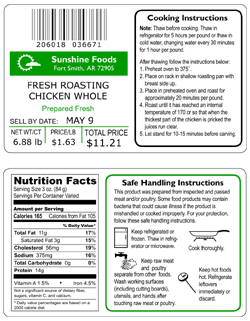
Fresh chicken should be stored in the refrigerator at 40°F or lower. It should be used within two days of the date on the package and if it is not going to be used within that time, it should be frozen. Freezing should be avoided if possible because it causes the chicken to be less tender and juicy but if it will not be used within that time, it should be frozen to prevent it from perishing.
When freezing, be sure the chicken is as fresh as possible. Remove it from the package it came in and rewrap tightly, using plastic wrap, foil or freezer paper. If you are storing for more than two months, double wrapping is suggested. Be sure the wrap is pulled tightly against the entire surface of the chicken to prevent ice crystals from forming in areas that are not wrapped tight. Ice crystals form in these areas because moisture has been drawn out of the meat, causing the chicken to become tough in these areas. This condition is known as "freezer burn." Mark the wrapped package with contents and the date so you can be certain of how long it has been stored in the freezer.
The chicken should be frozen as quickly as possible. The quicker it freezes the better it will be when thawed. To speed up the freezing process, place the package on the floor or against the wall of the freezer since these are the coldest parts. It is always best to freeze and store frozen food in a freezer unit, rather than a refrigerator freezer. The freezer units will maintain a temperature of 0°F or below, which will allow food to be stored for longer periods of time. A refrigerator freezer will generally only maintain a temperature of 10°F to 25°F and is opened more often, which causes fluctuation in temperature. If meat is stored in a refrigerator freezer, it should be used within two or three months. Whole chicken stored in a freezer unit can be stored safely for up to a year, and chicken pieces can be stored up to nine months.
Storage Times
(Suggested times for maximum quality) |
| |
Refrigerator (40°F) |
Freezer (0°F) |
| Whole Chicken |
Two to Three Days |
Twelve Months |
| Chicken Parts |
Two to Three Days |
Nine Months |
| Giblets |
One Day |
Three Months |
| Ground Chicken |
One Day |
Three Months |
| Cooked Chicken |
Three to Four Days |
Three to Four Months |
|
Note: If storing longer than the storage times shown above, double wrapping is suggested to help keep in moisture. |
Freezing Tips:
- Use moisture proof wrap or bags when freezing chicken. Wax paper is not moisture proof and should not be used because it would not hold the moisture in the meat.
- Be sure all packages are marked with the content and the date it was frozen.
- Wrapping individual chicken parts in foil or with freezer wrap and then placing in a freezer bag will allow you to take out only the number of pieces you will need.
- Freeze fresh chicken as soon as possible to maintain the best quality.
- Store frozen chicken in a freezer unit to obtain maximum storage time.
- Thaw frozen chicken using one of three methods: in the refrigerator; in cold water, changing every 30 minutes; or in the microwave. NEVER thaw chicken at room temperature.
|