|
Cuts of Ham
Hams are cuts of pork that come from the hind leg. The different cuts from the ham are shown below.
| Ham Cuts |
Description |
|
Whole Ham
Includes both the butt and shank cuts of the leg. The whole ham can weigh 10 to 20 pounds. |
|
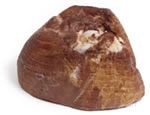
Butt End
|
The upper cut of the hog's hind leg. The butt end is meatier but contains more fat than the shank end of the whole ham and is harder to carve because it contains the hip and pelvic bone. If the cut is found labeled " butt half", it has not had the center ham slice removed. If the center slice has been cut from it, the cut will be labeled " butt portion". |
|
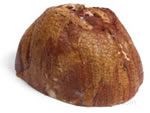
Shank End
|
Lower cut of the hog's hind leg. The shank end contains less fat, is not as meaty as the butt end, but it contains only one leg bone, making it easier to carve. It has a slightly sweeter flavor. If the cut is found labeled " shank half", it has not had the center ham slice removed. If the center slice has been cut from it, the cut will be labeled " shank portion". |
|
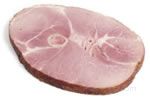
Center Ham Slice
|
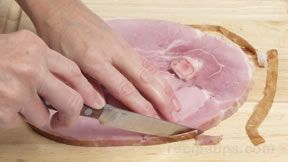
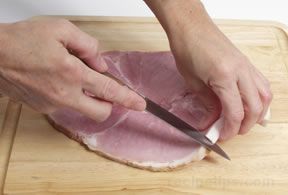
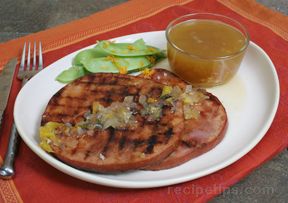
Also referred to as center cut ham steak, this cut is approximately ½ to 1 inch thick and is sliced from the center of the ham where the butt end and shank end are separated. It is available cured and smoked. The center ham slice is the best cut from the ham. |
Ham Types
Hams are available fresh or cured, and sometimes smoked. There are many different varieties of ham, which differ according to the methods used in curing and processing. The curing process is used to preserve, develop a deeper color, and intensify the flavor of the ham. Hams are larger cuts used to serve several people. A whole ham can weigh 10 lbs. to 20 lbs. or more, but are generally sold in halves. They are fairly low in fat but high in sodium and are available bone-in, semi-boneless or boneless. There are three basic types of ham. The types are explained below.
| Ham Types |
Description |
|
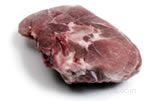
Fresh Hams
|
Fresh hams are cuts from the hind leg that are not cured or smoked. They are grayish-pink in color when raw and when cooked they are grayish-white. Fresh hams are cooked using the same methods used for other fresh pork cuts and have a similar flavor to pork roast. |
|
Dry-Cured Hams
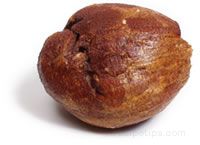
Sometimes referred to as country hams, they are cuts from the hind leg of a hog that have been cured without the injection of water. A curing compound consisting of salt and other ingredients, which may include sugar, sodium nitrate, nitrates, phosphates, and other seasonings, is rubbed on the surface of the ham. The ham is then hung to dry, allowing it to age anywhere from a few weeks to over a year, depending on the variety of ham. Generally, the aging process is approximately six months. During this time the curing compound penetrates through the entire ham, drawing out moisture and thereby preserving the ham. The weight of the ham is reduced 18 to 25 percent. The loss of moisture produces a more intense flavor and deepens the color of the ham. Dry-cured hams may also be smoked. Ham that is dry cured is saltier and drier than the typical ham you find in normal food stores.
|
|
Because of the lengthy curing time, country hams often form a layer of mold on the outside. This mold is not harmful, but is rather an indication of proper aging. The mold can easily be scrubbed off. |
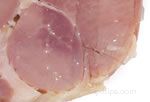 |
Frequently aged ham will also develop white specks through out the meat. The specks do not affect the quality of the meat. |
Because of the saltiness of the country hams, they are generally soaked before they are cooked to help reduce the salt content. Dry-cured country hams may be found in a market near the area in which they are produced but typically they have to be special ordered. There are also dry-cured hams available that are not country hams, such as prosciutto ham, which is a lightly salted dry-cured ham that is air-dried for many months and served raw. |
|
Wet (or Brine) Cured Hams
|
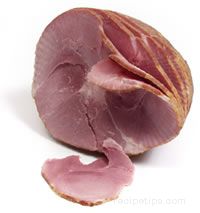
Also referred to as city hams, they are cuts from the hind leg of a hog that have been cured by soaking or injecting with water and brining ingredients. The curing solution consists of water and brining ingredients, such as salt, sugar, sodium nitrite, sodium nitrate, honey, spices, seasoning, and artificial flavoring. The ham may also be cooked or smoked during this process. Wet cured city hams are mass-produced and generally ready for market in one to seven days. Their flavor is less intense than a dry-cured ham. The city ham is the type of ham commonly found in a typical food store. It is popular for its pink color, moistness, and sweet flavor. |
Smoked Ham
The process of smoking the hams takes place after they are cured. Not all hams are smoked but many are smoked to add color and flavor to the meat. After curing, the hams are hung in smoke houses where they are exposed to the smoke and temperature of smoldering hardwood fires. Red oak and hickory are two of the most popular hardwoods used but others, such as apple, pecan, and maple are also used, each imparting its own unique flavor. The smoked flavor does not actually penetrate through the meat but imparts an aroma. Some processors add smoke flavoring by adding liquid smoke to the curing solution.
Smoking also aids in the curing process by drying the meat as moisture exudes and because the smoke is toxic to the pathogens, it sterilizes the surface of the meat. Proper temperatures must be maintained during the smoking process to produce the desired product. Some hams are smoked at a higher temperature to produce a cooked ham. This process is called "hot smoking" and raises the meat temperature to 135° to 140°F. Hot smoking is generally used as an alternative to boiling or baking a wet cured ham. A process called "cold smoking" is generally used on dry-cured hams. Cold smoking is accomplished at a temperature ranging from 70° to 110°F. It assists in the drying process and imparts an aroma to the meat but does not actually cook the ham
Ham - Water Content
The amount of water contained in a ham will affect its taste, texture and price. Most hams will fall in one of the 4 categories shown below.
Ham
A ham labeled just "Ham" must be at least 20.5% protein in the lean area and have no water added. This type of ham is dry cured, having no water added. They are generally sold in specialty stores or must be special ordered. They have an intense flavor and are very salty. The ham is sliced very thin when served.
Ham with Natural Juices
A ham labeled "Ham with Natural Juices" contains at least 18.5% protein and has had a small amount of water added when cured. Its cured weight cannot be more than 8% higher than its uncured weight. This ham is moister and has a smoother texture, making it a popular choice for a special dinner.
Ham - Water Added
A ham labeled "Ham - Water Added" contains at least 17% protein and has no more than 10% added solution. Its cured weight cannot be more than 8% higher than its uncured weight. The added water content makes this ham more versatile. It is commonly used for steaks and slices.
Ham and Water Products
A ham product that is less than 17% protein and it can contain any amount of water. The water content must be clearly stated on the label as a "% of added ingredients." This type of ham is great for thin slicing and shaving. Commonly found in the deli for sandwich meat.
The more water the ham contains, the lower the price will be. But it also lowers its nutritional value and makes the meat more perishable.
Ham - Bone-In / Boneless
Ham is available in different forms, such as bone-in, semi-boneless, and boneless.
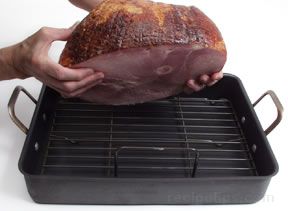
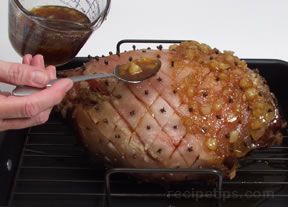
Bone-in Ham - This type of ham can be a butt or shank portion or it could be a whole or half leg that has the hip, thigh and/or shank bone remaining as part of the ham. Bone-in hams are more attractive and flavorful.
Semi-Boneless Ham (Partially Boned) - A ham from the leg primal cut that has only the leg bone remaining. The hip or shank bone has been removed, making it easier to carve. The remaining leg bone helps to make the ham more flavorful.
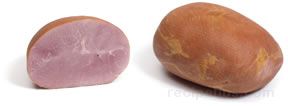
Boneless Ham - A round, oblong or rectangle-shaped cut that has the hip, thigh and shank removed. It has also had most of the fat removed. Boneless hams are easier to carve because there is no bone to carve around but without the bones, the ham will lack the flavor found in a bone-in ham. The texture is also affect by the processing methods used to remove the meat from the bones. There are also boneless hams produced from small chunks and reformed hams (oval shaped), which are meant to be sliced and used for sandwiches.
Ham - Cooked / Uncooked
Fully Cooked Ham - A ham that has been thoroughly heated during some part of the processing to a temperature exceeding 147° F, making it ready to eat without further cooking. These hams are found labeled "Fully Cooked," "Ready to Eat," or "Heat and Serve." They may be eaten right out of the package or they can be warmed to an internal temperature of 140° F to provide a richer flavor.
Partially Cooked Ham - A ham that has been heated during some part of the processing to an internal temperature exceeding 137°F but less than 148° F. Most commercially processed hams are heated to a temperature of 140° F. Temperatures reaching 137° F will kill the trichinella spiralis parasite. A partially cooked ham still requires additional cooking prior to eating. It must be heated to an internal temperature of 160° F.
Uncooked Ham - A ham that had not reached an internal temperature exceeding 137° F during processing. Uncooked hams are generally dry-cured hams, although dry-cured hams are also available fully cooked. An uncooked ham requires more preparation time and cooking time than a partially or fully cooked ham.
Boiled Ham - A ham that has been boned, cured and fully cooked using a process that includes boiling the ham in water. It is ready to serve as sliced ham or ham pieces. |