|
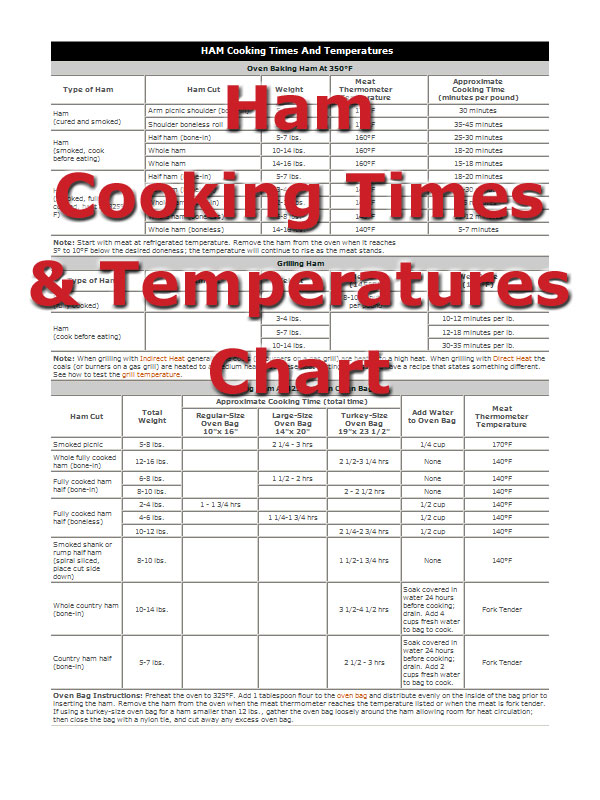
There are some basics on how to cook a ham that you should keep in mind before you are going to prepare and bake a ham. The storage and handling of the ham is important to ensure that your ham recipes are prepared safely. Raw pork must be stored in the refrigerator at 40°F or lower and used within three to five days of the "sell by" date on the package or it should be frozen. If you are starting with a frozen ham it must be thawed and stored properly. Be sure to use the correct cooking times and temperatures when baking or roasting ham to achieve proper doneness. Learning how to bake a ham is easy with the right help; see the Ham Cooking Guide for more information on how to cook a ham.
| ||||||||||||||||||||||
| Note: Ham can be cooked without thawing first. You will need to increase the cooking time when starting with frozen meat. Larger cuts, such as roasts, will require up to 1 ½ times the cooking time of an unfrozen cut. |
Refrigerator Method
Thawing pork in the refrigerator is the slowest but safest method and will result in the least amount of moisture loss in comparison to the other methods. The temperature of the refrigerator should be maintained at 35°F to 40°F to discourage growth of harmful organisms as the meat thaws. Leave the meat wrapped and placed on a platter or a tray to catch the drippings as it thaws or unwrap and loosely cover with plastic or foil.
Approximate Refrigerator Thawing Time
| Small Ham | 4 to 5 hours per pound |
| Large Roast | 5 to 7 hours per pound |
After thawing in the refrigerator the pork can be refrigerated safely for 3 to 5 days. If you decide not to cook the meat within this time, the meat can be refrozen. Remember however, that each time the meat is frozen it loses some of its flavor quality. Do not refreeze meat that has been thawed using the cold water or microwave methods.
Cold Water Method
Thawing pork in cold water is a faster method than thawing in the refrigerator and it is safe as long as the proper precautions are taken. Fill the sink with enough cold tap water to cover the cut of meat, place the pork in a leak proof bag and put it into the cold water. Be sure that the meat is sealed tightly so that it is not exposed to the water. Meat exposed to the water will result in flavor and color loss, and will have a greater chance of bacterial growth. The water must be replaced with fresh cold water every 30 minutes. Do not use warm or hot water because it will encourage the growth of bacteria.
Approximate Cold Water Thawing Time
| Small Ham | 2 to 3 hours |
| Large Roast | 30 minutes per pound |
Do not use the sink for other purposes during the thawing period and be sure the water does not splash onto other preparation surfaces or food. Once the meat is thawed, remove it from the sink and sanitize all utensils and surfaces affected during the thawing period. The pork should be cooked immediately after thawing and should not be stored for any period of time. Do not refreeze the meat that has been thawed using this method, unless it has been cooked first.
For more information on ham preparation, see the Ham Preparation Guide.
Baking
- To make clean up easier, line your roasting pan with aluminum foil.
- Do not add water to the roaster.
- To avoid drying out ham, cook slowly at 325ºF. Allow 20 to 30 minutes per pound for ham that has not been precooked (follow directions on label for precooked hams).
- Begin roasting ham by placing fat side up, the melting fat will baste your ham. Turn ham over half way through baking to avoid uneven salting from the brine in the meat.
- For a crisp surface on your ham roast, be sure the oven is preheated before placing the roast into the oven in an uncovered pan.
- Do not use sharp utensils that may pierce the ham when trying to turn it. The piercing allows valuable juices to escape. Use other utensils, such as wooden spoons and spatulas for turning the meat.
- Use proper cooking times and temperatures. Do not overcook pork or it will become dry and tough. The threat of trichinosis is eliminated when the pork is heated to 137°F but the USDA recommends cooking pork to 145°F to be safe. Cooking to 145°F will result in clear or slightly pink tinted juices from the juicy and tender meat.
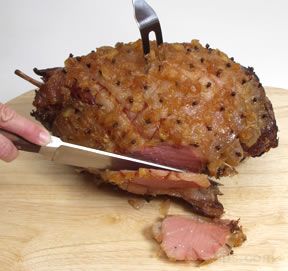
- After ham has completed roasting, take ham out of oven and let stand 15 minutes before slicing. Ham will continue to bake when out of the oven and letting ham stand for 15 minutes makes it easier to carve.
- Do not partially cook pork and then store in refrigerator to use later. It must be cooked until done.
Check for Doneness
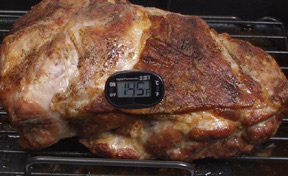
Using a thermometer is the most accurate method for testing doneness. A regular meat thermometer is inserted before placing the meat in the oven or other heat sources and it remains there throughout the cooking time. An instant read thermometer is used to check for the proper temperature once the meat has been cooked. The meat is removed from the heat source and the instant read thermometer is inserted into the thickest part of the meat to provide a temperature reading in approximately 15 seconds. When either type of thermometer is inserted into the meat of a bone-in ham, it must not be touching a bone or it will result in an inaccurate reading.
 |
Remove the ham when it has reached a temperature that is 5 to 10 degrees lower than the recommended temperature for doneness (refer to chart below). During the 10 to 15 minute resting period, the ham will continue cooking and will reach the proper temperature. Following this method will ensure that the meat will not be overcooked. |
|
Internal Temperatures for Proper Doneness | |
|
Fresh Hams |
145° - 155°F |
| Whole Leg or Half Leg | 145° - 155°F |
| Smoked Whole or Half Ham | 145°F |
| Smoked and Fully Cooked Ham | 130° - 140°F |
Jazz it up
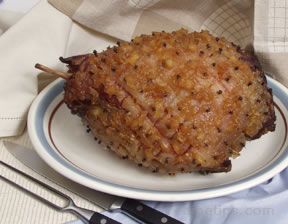
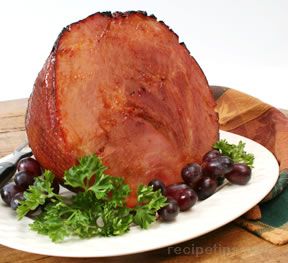
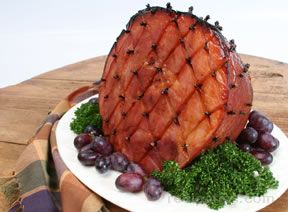
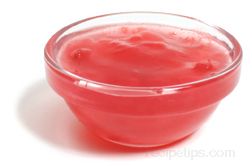
If you purchase a ham that has not been pre-glazed, jazz it up! Try the Honey Baked Ham with Cloves recipe or create one of the ham glazes below to enhance the flavor.
- Mix equal amounts (approx. ¼ cup, depending on size of ham) of powdered mustard and brown sugar. Sprinkle mixture over ham surface for the final 30 minutes of cooking.
- Mix equal amounts (approx. ¾ cup, depending on size of ham) orange juice, and pear juice. Baste ham twice within the first 15 minutes of baking.
- Mix equal amounts (approx. ¾ cup, depending on size of ham) of brown sugar and honey. Brush sugar and honey mixture over ham during the last ½ hour of baking.
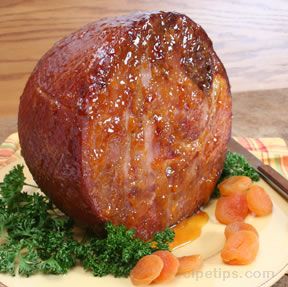
- Mix 1 cup of raspberry preserve (or cherry, apricot, etc) with ½ cup of light corn syrup. Mix until well blended and brush on ham during the last 15 to 30 minutes of baking.
For more information on baking ham, see the Ham Cooking Guide.