RecipeTips.Com Home cooking tips & advice | Knowledge | Tying Beef
Join Now | Sign In | RSS Feeds RSS Feeds
Tying Beef: Easy How-To Cooking Tips & Advice: RecipeTips.com
Recipes Cooking Tips & Advice Glossary Community Videos
hints
e-Newsletter
RecipeTips.com Newsletter Sign Up

Tying Beef

print Print Tying Beef article  |  email Email Tying Beef article  |  rate this article Rate this article  | Bookmarks
Meat > Beef > Beef Preparation Guide > Tying Beef

Tying a Rib Roast | Tying a Tenderloin | Tying a Top Blade Chuck Roast


Tying various cuts of beef is a good way to hold the shape of a roast, to keep the cut of beef in a compact form, and to make sure that the meat will be cooked evenly. Beef roasts or steaks that have been boned are often rolled and tied before roasting. The tying allows the roast to be stuffed and makes for a more attractive presentation when serving.


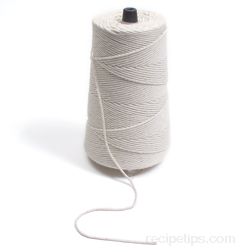
It is important to use a natural string of cotton or linen which will not burn during the cooking process or ruin the flavor of the beef. Butcher's string is the best to use because it is a bit heavier than other types of common kitchen string, which makes it easier to handle. When tying a cut of beef, it is important that the string is tight enough so that the desired shape is held in place, but that the string is not so tight that the natural juices will be squeezed from the meat during the cooking process.

Tying a Rib Roast

Standing Rib Roast

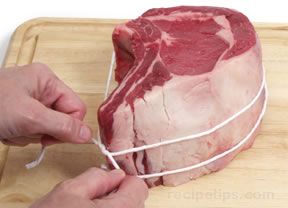
It is usually a good idea to tie a standing beef rib roast (a rib roast in which the bones have not been removed) so that the outer layers of meat do not pull away from the rib-eye during the roasting process. Using a simple knot, tie pieces of string around the roast so that the string runs between the spaces of each of the rib bones.

Tying the standing rib roast will make for a more attractive presentation when the roast is served because when the string is removed after cooking, the roast will hold its shape.

Boneless Rib Roast

It is much easier to carve a boneless rib roast when it is ready to serve than one that still includes the bones; however, it is beneficial to cook the bones with the boneless meat in order to provide the rib roast with additional flavor and moistness. To this end, if you have previously removed the bones from the roast, it will be necessary to tie the bones to the meat prior to cooking.

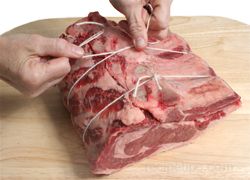
Tie the bone section (chine bones and rib bones that have been removed in one piece) to the boneless meat using butcher's string. Wrap the string between the rib bones and around the meat on each end of the roast. Make sure the chine bones are secure as well. In addition, tie string around the meat and bones in the center of the roast.

Tying a Beef Tenderloin

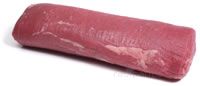
In order for the tenderloin to cook properly, the narrow end is usually tucked under so that the entire tenderloin appears to have a consistent diameter across the length of the roast. The tenderloin is then tied with pieces of string at 1˝ to 2 inch intervals.

Tying a Top Blade Chuck Roast

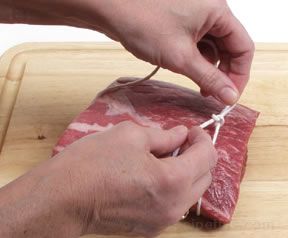
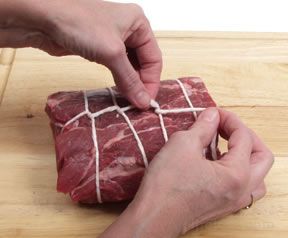
Tying a top blade chuck roast provides better results for pot-roasting. The first step is to wrap a piece of string, which is at least 6 feet in length, around the short circumference near the end of the roast and tie a double knot.

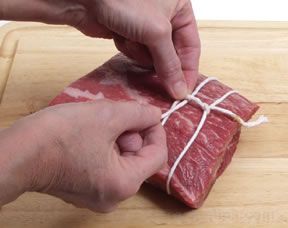
Pull the remaining string down from the knot, approximately 1 to 2 inches (depending on the size of the roast), and hold it in place with your thumb. Loop the remaining string around the short circumference of the roast and back to the string under your thumb.

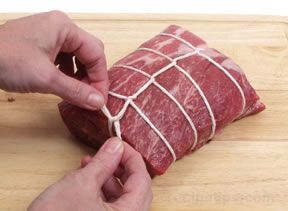
Run the string under the string beneath your thumb to create a loop and pull the remaining string down from the loop.

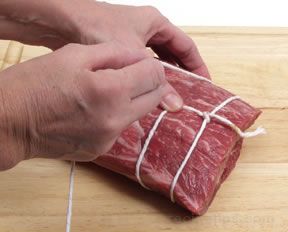
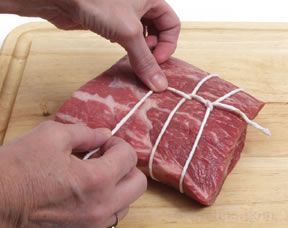
Once again, place your thumb on the string at a 1 to 2 inch distance from the previous loop and run the string around the roast back to the position of the string beneath your thumb to make another loop. Repeat the process until the entire length of the roast has been tied.

Roll the roast over and run the string over and around each of the loops on the underside.

Wrap the remaining string around the end of the roast and then flip the roast over again to tie the end of the string to the original knot.

More Beef Preparation Guide >>

Tying Beef article - Related Content

Cooking Tips & Advice
Beef Cooking Times

Beef Cooking Times

Beef cooking temperatures are important to monitor in order to insure meat is safely cooked to the proper temperature. When preparing beef, use the chart below as a guide to ...
Beef Rotisserie Cooking

Beef Rotisserie Cooking

General Guidelines | Charcoal Grill | Gas Grill | Doneness Rotisserie cooking requires three key components: The spit assembly, a means to turn the spit, and a heat ...
Beef Recipes

Beef Recipes

Beef Article
Tying Pork

Tying Pork

The process of tying meat is used to ensure even cooking and helps hold the shape of the cut. Tying is used on several different cuts and there are several styles of tying ...
Beef Doneness

Beef Doneness

General Guidelines | Degree of Doneness | Meat Thermometers General Guidelines Even though harmful bacteria are usually only on the surface of whole beef cuts, there ...
Recipes view more
Beef Tacos with Onion Jam and Horseradish Cream

Beef Tacos with Onion Jam and Horseradish Cream

A British variation on a Mexican favorite—the traditional beef and horseradish of England becomes part of a Mexican taco filled with a tasty onion jam that makes the flavor of this beef taco recipe so distinctive.
Beef and Biscuit Bake

Beef and Biscuit Bake

A clever way to use simple ingredients to create an easy to prepare, rib-sticking main dish.
Beef Crostini with Red Pepper Mayonnaise

Beef Crostini with Red Pepper Mayonnaise

The flavor of the roasted red pepper and basil pairs well with the beef tenderloin in this wonderful Italian style hors d’ oeuvre.
Beef Fajitas

Beef Fajitas

Fresh ingredients and a mildly flavored marinade highlight these wonderful, easy to prepare wraps filled with grilled beef, onions, and peppers.
Beef or Lamb Tagine

Beef or Lamb Tagine

A moist and flavorful way to prepare beef or lamb with tasty vegetables.
Glossary Terms
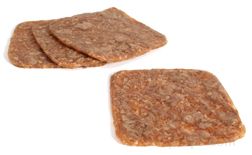
Beef Loaf

Beef Loaf

A sandwich meat that is made with cooked beef shavings encased in gelatin and formed into a rectangular-shaped loaf approximately 12 inches in length that is typically 4 inches ...
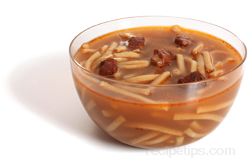
Beef Noodle Soup

Beef Noodle Soup

A hearty noodle soup made from a combination of egg noodles, small chunks of beef, beef stock, and seasonings. Beef Noodle Soup provides a beefy flavor enhanced with the addition ...
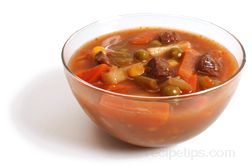
Beef Barley Soup

Beef Barley Soup

Hearty and quite filling, this savory soup can be be served as a main meal for lunch due to the quantity of ingredients typically added to the soup. Most often Beef Barley Soup ...
Beef Chuck

Beef Chuck

The area of a steer that extends from the neck to the fifth rib of the chest cavity. Included in the Beef Chuck is the meat extending from the shoulder to the arm most often ...
Beef Stew

Beef Stew

A food dish that combines beef with a variety of other ingredients, such as potatoes, vegetables, herbs, spices, and broth to create a savory dish, rich in flavor and often served ...
USDA Nutrition Facts

Beef bologna reduced sodium

Beef brisket flat half separable lean and fat trimmed to 18 fat choice cooked braised

Beef brisket flat half separable lean and fat trimmed to 18 fat select raw

Beef brisket flat half separable lean and fat trimmed to 18 fat choice raw

Beef flank separable lean only trimmed to 0 fat select raw

Quick Tags
  Beef   Beef Preparation Guide   Meat
Summer Of Grilling Giveaway
Advertise With Us ADVERTISEMENT
Daily Feature
Pear and Provolone Pizza Recipe
view past daily features
Party Planner
RecipeTips.Com Home cooking tips & advice | Knowledge | Tying Beef
Join Now | Sign In | RSS Feeds RSS Feeds
Reproduction in whole or in part without written permission is strictly prohibited.
© Copyright 2008 Tecstra Systems, All Rights Reserved, RecipeTips.Com