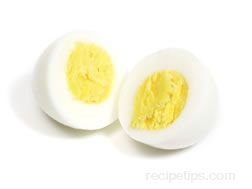
| Using the term boiled when referring to eggs cooked in the shell can be misleading, because eggs known as "hard-boiled" should never be cooked at a full boil for the duration of the cooking time. Eggs cooked in the shell with heat that is too high or with a cooking time that is excessive, will become tough and rubbery and a dark line may form between the yolk and the white. The term, hard-cooked, is a more accurate name for eggs cooked in the shell using hot or boiling water. |
Cooking
| The following steps can be used for making hard-cooked eggs. |
| Pierce the large end of the eggs with a pin or needle. This pierces the air cell in the egg, allowing the air to escape, which prevents a flat spot from forming on the large end of the egg during the cooking process. It also helps to make the eggs easier to peel after cooking. | 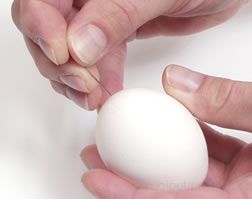 |
| Pour cold water into a saucepan and add 1½ teaspoons of salt per quart of water. (The salt may help make the peeling process easier). Make sure there is enough water in the pan so that the eggs will be completely covered with the water. Bring the water to a boil; then with a large spoon, place the eggs in a single layer on the bottom of the pan. | 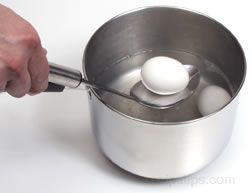 |
| When the water returns to a boil, turn down the heat so that the water is at a low simmer; then begin timing the eggs for the desired doneness. Do not cover the pan. | 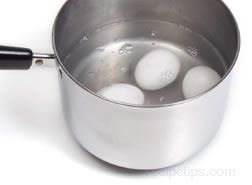 |
|
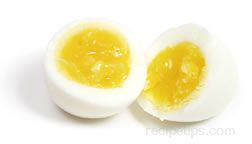
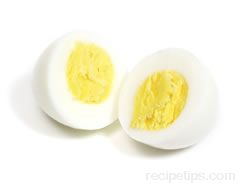
The following cooking times can be used as a guide to achieve the |
| Degree of Doneness | Egg Size/Cooking Time |
|
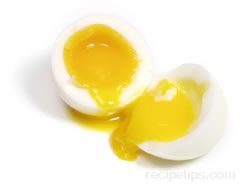
Soft-cooked Yolk |
Medium Egg = 4 minutes Large Egg = 5 minutes Extra Large Egg = 6 minutes |
|
Medium-cooked Yolk |
Medium Egg = 6 minutes Large Egg = 7 minutes Extra Large Egg = 8 minutes |
|
Hard-cooked Yolk |
Medium Egg = 11 minutes Large Egg = 12 minutes Extra Large Egg = 13 minutes |
|
After the required cooking time has elapsed, run cold water over the eggs to stop the cooking process. This will help prevent discoloration of the yolk and will also make the peeling process easier. The cold water creates steam between the egg white and the shell, which makes the shell easier to remove. |
| Note: The temperature of the egg at the start of the cooking process will affect the cooking time. You may subtract one minute from the cooking times listed in the chart if the eggs are at room temperature at the beginning of the cooking process. The cooking times listed above are based on eggs taken directly from the refrigerator. |
Peeling
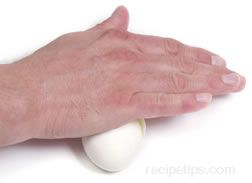
Roll and PeelTo peel a hard-cooked egg, simply roll it over a hard surface, using light pressure. This will crack the shell, making it easier to remove. It is also worth noting that soft-cooked eggs are more difficult to peel than hard-cooked eggs, and very fresh eggs are more difficult to peel than older eggs. |
 |
Egg Shell Cutting ToolA tool known as an egg shell cutter is similar to a scissors in design and is used to snip off the top of a soft-boiled egg so it can be eaten while still in the shell. It is often made of stainless steel and is also known as an egg topper, egg snipper, or egg shell scissors. |
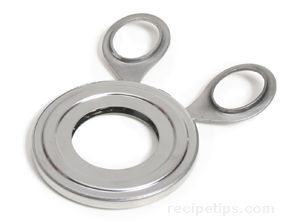 |
| To use the egg shell cutter, place it over the tapered end of the egg and squeeze the two handles to close the ring of teeth. The teeth pierce the egg shell, making a ring around the shell. | 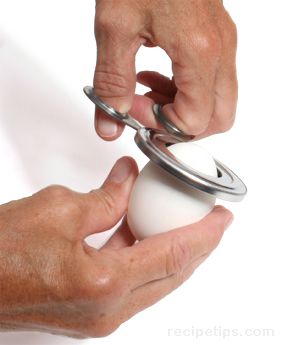 |
| The teeth cut through the shell just enough so that the top of the shell can be lifted up and removed from the rest of the shell. The egg can be placed in a small egg cup with the open end up, so that it can be served, or if the egg is hard-cooked, the remaining shell can be removed prior to serving. | 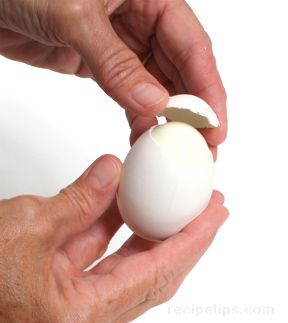 |
Serving
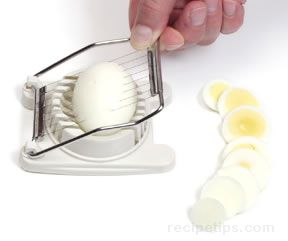
Using an Egg SlicerHard-cooked eggs can be served whole or they may be cut and sliced. An egg slicer can be used to prepare evenly sliced sections that can be used in salads or as a garnish for a variety of recipes. The egg slicer is a tool that consists of a tray that is hinged to a cutter, which is constructed with a series of stiff wires. Each of the wires acts as a cutting instrument, slicing through the egg when pressure is applied to the cutter. The egg is placed on its side in the tray, and the cutter is closed down over the egg, producing slices of equal thickness. |
 |
| The egg can be rotated and sliced a second time or even a third time in order to chop the egg in pieces as small as you would like. | 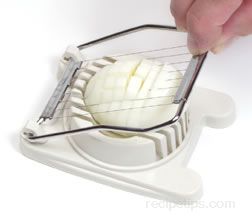 |
Using an Egg Wedger |
| An egg wedger may also be used and is similar to the slicer in design except that the egg sits upright in the tool instead of on its side. The cutting tool produces equal wedges instead of slices. The wedger can also be used to cut only the top portion of the egg to create a decorative design and to produce a cavity at the top which can be filled with other ingredients. |
Halving the Hard-cooked Eggs | |
| Hard-cooked eggs can also be cut in half the long way so that the solid yolk can be removed from the two halves. The yolk is then blended with other ingredients such as mayonnaise, mustard, and seasonings and the mixture is stuffed back into the yolk cavity of the egg halves. This type of egg dish is known as a stuffed egg or a deviled egg and is served as a hors d'oeuvre or appetizer. | 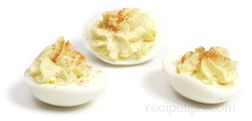 |