|
Roasting
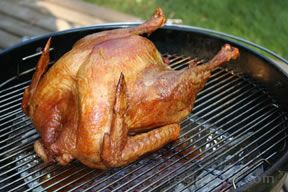
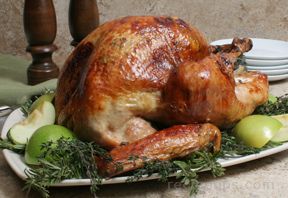
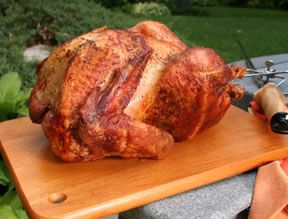
Roasting is a dry heat cooking process and is one of the most popular methods used for cooking turkey. The roasting process tends to evaporate and reduce the moisture content of any type of meat, shrinking the fibers and making the meat tougher, so it is important to follow the proper steps for roasting to ensure the best results.
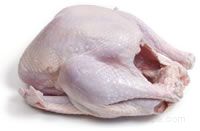
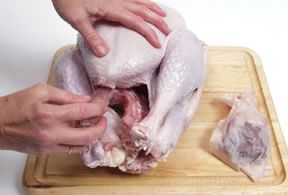
| In order to prepare the turkey for roasting, the neck and giblets, which are usually placed inside the body cavity when the turkey is processed, must be removed. |
 |
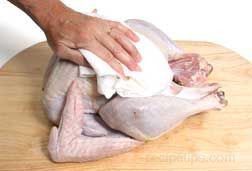
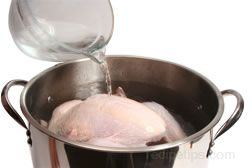
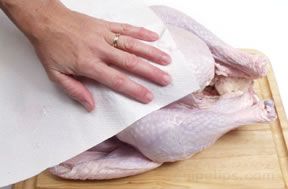
| Rinse the turkey inside and out with cold water and pat the surface dry with paper towels. |
 |
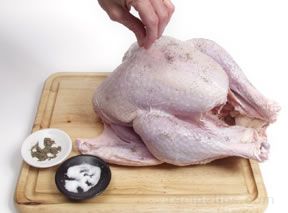
| The turkey can be seasoned with salt and pepper and with any herbs and spices that are desired, but this is optional. |
 |
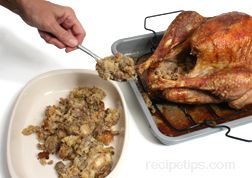
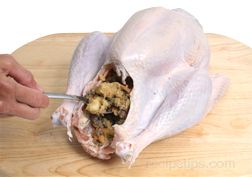
| If the turkey is to be stuffed, the stuffing should be inserted into the body cavity just before the bird will be placed in the oven. It is a dangerous practice to stuff the turkey in advance with the idea that time will be saved. The stuffing may promote the rapid growth of harmful bacteria if the turkey is not cooked immediately after stuffing. Do not overstuff the turkey because the stuffing will expand as it cooks. |
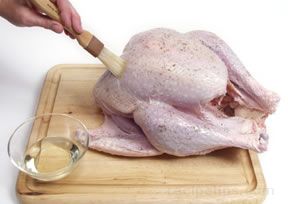
| The turkey may be coated with oil or butter to help brown the skin, but this is optional. |
 |
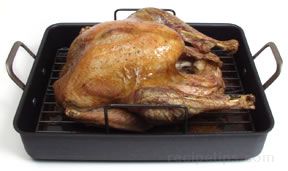
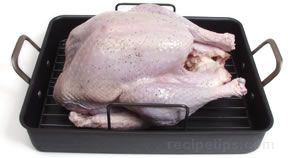
| Place the turkey breast side up on a cooking rack in a shallow roasting pan and place the pan in the center of the lowest rack of a preheated oven. |
 |
| Roast the turkey uncovered at a temperature ranging from 325°F to 350°F. Higher temperatures may cause the meat to dry out, but this is preferable to temperatures that are too low which may not allow the interior of the turkey to cook to a safe temperature. Some cooks prefer to roast the turkey at temperatures as high as 450°F to 500°F for the first 30 minutes to brown the surface and then reduce the heat to 325°F. It is important to keep the oven door closed as much as possible while the turkey is roasting to maintain a constant temperature in the oven. |
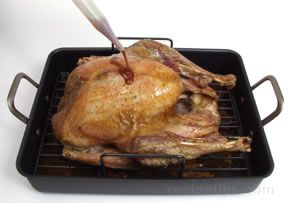
| Basting a turkey provides a crispy, golden skin, but it does not add moisture or flavor to the interior of the turkey. Basting should be kept to a minimum so that the oven door is not opened too often. The more times the oven door is opened, the longer the cooking time will be due to loss of heat. |
 |
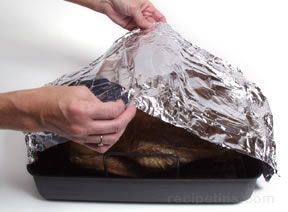
| Aluminum foil can be tented over the turkey near the end of the cooking time to keep the skin from becoming too brown. |
 |
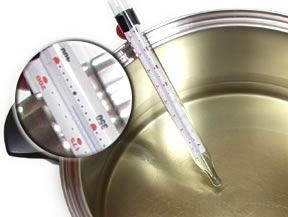
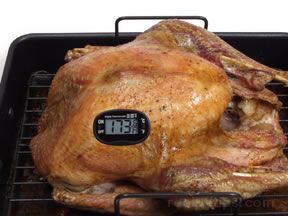
| Use a meat thermometer to determine the proper doneness, which is at least 170°F for the breast and 180°F for the thigh. After removing the turkey from the oven, the temperature of the meat will increase by about 5° as the turkey rests. It is important to not let the turkey overcook, because the breast meat may quickly dry out. |
 |
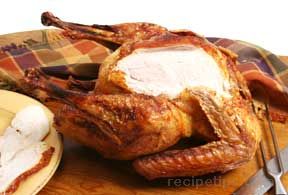
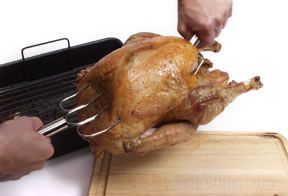
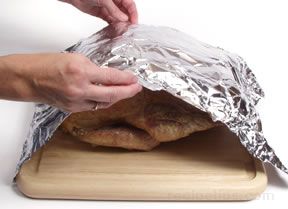
| After removing the turkey from the oven and before carving, allow the turkey to rest at least 20 minutes so that the juices settle within the meat, which will provide the meat with more flavor and tenderness and will also make carving much easier. More or less time may be allotted depending on the size of the turkey. Large lifting forks, like those shown in the picture at the right, or other types of turkey lifters should be used to remove the turkey from the roasting pan. After the turkey is placed on a large cutting board, it can be tented with aluminum foil to retain the heat while it is resting. |
 |
 |
| Note: A disposable aluminum pan is not recommended for roasting a whole turkey. The weight of the turkey may cause the pan to buckle when it is removed from the oven, creating a dangerous situation. |
Roasting times may vary greatly, depending on a number of variables that affect the cooking time such as the shape of the turkey, the proportion of meat to bone, the variations in different ovens, the altitude, and if the turkey is fresh or frozen and then thawed. Adding the confusion is that almost every source providing roasting times is different from one another. Listed below are roasting times that can be used as a general guideline, but the only true gauge for determining proper doneness is with a meat thermometer. The breast must reach an internal temperature of 170°F and the thigh must reach 180°F.
| Roasting Times for a Whole Turkey Cooked in a 325°F Conventional Oven |
| Weight |
Unstuffed |
Stuffed |
| 8 to 12 pounds |
2¾ to 3¼ hours |
3 to 3¾ hours |
| 12 to 14 pounds |
3¼ to 3¾ hours |
3¾ to 4¼ hours |
| 14 to 18 pounds |
3¾ to 4¼ hours |
4¼ to 4¾ hours |
| 18 to 20 pounds |
4¼ to 4¾hours |
4¾ to 5¼ hours |
| 20 to 24 pounds |
4¾ to 5½ hours |
5¼ to 6 hours |
| 24 to 30 pounds |
5½ to 6½ hours |
6 to 7 hours |
| Note: Using a convection oven will cut as much as 25% off the cooking times list above. |
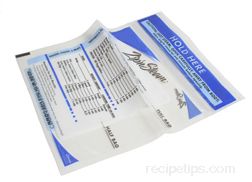
An oven-safe bag may also be used for roasting a turkey. The preparation and roasting steps are identical to the steps used for preparing and roasting a turkey without an oven bag except for the following additional steps:
- Add a small quantity of flour to the bag and shake it to coat the inside of the bag.
- Place the turkey inside the bag and close the opening with the twist tie provided.
- A few holes should be punctured in the bag to allow some steam to escape during the roasting process.
The oven-roasting bag keeps the turkey very moist and it speeds up the roasting time. The following cooking times can be used as a guideline for an unstuffed turkey roasted in an oven bag in a 350°F conventional oven. An additional 30 minutes or more may be required for a stuffed turkey. The only true gauge for determining proper doneness is with a meat thermometer. The breast must reach an internal temperature of 170°F and the thigh must reach 180°F.
| 8 to 12 pounds |
1½ to 2 ¼ hours |
| 12 to 14 pounds |
2¼ to 2¾ hours |
| 14 to 18 pounds |
2¾ to 3½ hours |
| 18 to 20 pounds |
3½ to 4 hours |
| 20 to 24 pounds |
4 to 4¾ hours |
| 24 to 30 pounds |
4¾ to 5¾ hours | |