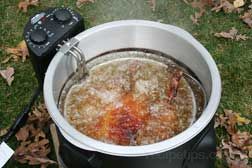



| Extreme care is necessary to ensure safety when deep-frying a whole turkey. Because the required equipment can be cumbersome and the large quantity of hot oil necessary for cooking a whole bird can be dangerous, deep-frying a whole turkey is much less safe than deep-frying food on a smaller scale. It is important to note that Underwriters Laboratories has refused to certify any turkey deep-frying equipment because of the dangers involved. |
Listed below are some important points to consider when deep-frying turkey:
- Because of the size of the cooking equipment and the large quantity of oil required, deep-frying a whole turkey should never be attempted indoors. Pieces of turkey meat can be safely deep-fried indoors using traditional equipment such as a small pot on a stove top.
- When purchasing a deep-fryer designed for cooking whole turkeys, make sure the model has a solid base that will hold the cooking pot firmly. Models with tripod legs should be avoided because they can easily tip.
- The pot must be large enough to accommodate the turkey, but not so large that it becomes wobbly on the heating surface.
- Do not overfill the pot with oil. When the turkey is placed into the pot, the oil may spill over the sides and ignite on the heating unit.
- The temperature of the oil should be closely watched. If the oil overheats, it may ignite.
- If the turkey is not completely thawed when it is inserted into the hot oil, it may cause the oil to spill over because of the reaction of the hot oil to the frozen bird.
- Any utensils and equipment that come into contact with the hot oil must be thoroughly dried first. Moisture on the utensils will cause splattering when brought into contact with the hot oil, which can be dangerous.
- Make sure the turkey is as dry as possible before it enters the hot oil.
- The deep-frying equipment should be used a safe distance from all combustible substances. Never place the cooker on a deck, near any building, or on a table.
- The hot oil should not be left unattended and children and pets should NEVER be allowed near the cooking area.
- A fire extinguisher and heavy potholders should always be within reach.
- After the cooking is completed, the oil should not be transferred to another container or disposed of until it has completely cooled. It is extremely dangerous to pour the oil from the cooking vessel until it has cooled. Several hours may be required for the large quantity of oil to cool properly.
Deep-Frying
Deep-frying, also known as deep-fat frying, is a process of immersing food in deep pot containing heated oil, which cooks the food quickly, producing a crispy surface over a tender and moist interior. It is becoming a popular method for cooking whole turkeys. It is best if the turkey is smaller than 10 pounds for ease of handling and better results. Large turkeys are difficult to handle, which increases safety concerns when cooking with hot oil. Large turkeys also take too long to cook, resulting in an exterior that may be burned while the interior is still undercooked. A whole turkey can be cooked as is or it may be covered with a seasoned crumb coating, a dry rub, or injected with a marinade.
A cooking basket is a helpful accessory, allowing the turkey to be safely lowered and raised in the cooking pot containing the hot oil. A special hook designed for lowering and lifting the turkey may be included with some deep-fryer models, eliminating the need for a cooking basket.
| Any cooking oil can be used for deep-frying as long as it does not smoke or burn at temperatures that may reach as high as 425°F. Oil low in saturated fat is best to use because the turkey will absorb a small quantity of oil while it cooks. | |
| A temperature between 350°F and 375°F is an ideal range for deep-frying a turkey. Many deep-fryers have built in temperature gauges, but if no gauge is included, a candy thermometer can be used to determine the temperature of the oil. | 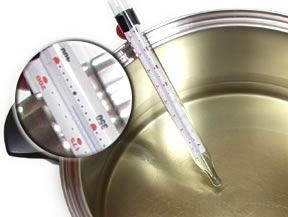 |
| Another method that can be used is to place a cube of bread into the oil and if it browns in 45 to 50 seconds, the oil is at the proper temperature. | 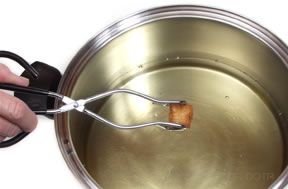 |
It is extremely important to use the proper quantity of oil when deep-frying a turkey. If too little oil is used, the turkey may not be totally covered with the oil when it is placed into the pot. If too much oil is used, the oil may overflow the sides of the pot when the turkey is inserted creating an extremely dangerous situation. Many deep-fryer models have gauges to determine the correct volume of oil to use for various weights of turkey. If no gauge is included with the equipment, the following steps may be used for determining the correct volume of oil to use for any quantity of turkey:
- Place the turkey in the pot using the special hook that may be included with the deep-fryer or if a cooking basket will be used, make sure the turkey is placed in the basket and then place the basket into the pot.
- Add water until the turkey is totally immersed and there is at least 2 inches of water above the turkey.
- Remove the turkey from the pot and measure the distance from the top of the pot to the surface of the water.
- Remove the water from the pot and dry it thoroughly.
- Add the oil to the pot up to the same level where the water had been.
The oil may take as long as an hour to heat depending on the quantity of oil and the type of heating equipment used. The turkey should be as dry as possible before it enters the hot oil. After the turkey is inserted into the pot, the temperature of the oil will begin to drop, so it may be necessary to increase the heat for a short time to return the oil to the proper temperature.
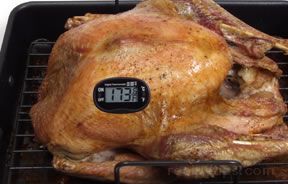
A whole turkey of 10 pounds or less requires a cooking time of 3 minutes per pound. To check for the proper doneness, carefully remove the turkey from the oil and check the internal temperature with a meat thermometer. The temperature should reach at least 170°F in the breast and 180°F in the thigh.