|
Food Safety Before, During, and After a Power Outage
Before
- Keep frozen water jugs in your freezer. Frozen ice jugs will serve as ice blocks for the refrigerator/cooler and freezer, as well as drinking water in the event of a power outage.
- Stock up on drinking water, one gallon per person per day. This would include drinking and sanitation. At least a 3 day supply is recommended.
- Store non-perishable foods in a convenient, dry place. In the event you do not have access to a heat source, such as a camping stove or outside grill, foods that do not require heating are best.
Examples of Non-Perishable Foods:
| Peanut butter |
Cold cereals |
Boxed/bottled fruit juices (unopened) |
| Canned vegetables |
Canned nuts & seeds |
Crackers |
| Canned/dried fruit |
Pre-made puddings |
Canned meats |
| Potato chips |
Granola bars |
|
Remember to pack a manual can opener. Non-perishable foods such as canned soups and macaroni and cheese taste better when heated. Keep this in mind when preparing your disaster kit.
- In the event severe weather has been predicted, turn up the temperature of your refrigerator and freezer.
- Know where dry ice can be purchased in the case of an emergency. Dry ice is the best option in keeping foods cold in a refrigerator, freezer, or cooler. Do not handle dry ice with bare hands. Wrap the dry ice in newspaper to prevent it from coming in direct contact with foods.
- Always keep an appliance thermometer in your refrigerator and freezer.
- Keep frozen foods close together in the freezer; it will help keep foods cold in the event of a power outage.
- Have an emergency preparedness kit ready. Recommended items for an emergency preparedness kit are provided at the end of this article.
During
- Place ice blocks in your refrigerator and freezer.
- Covering refrigerator, freezer, and cooler with thick blankets will help keep temperature down. Be sure not to cover refrigerator/freezer vents.
- Open refrigerator or freezer only when necessary.
- If outage is expected to last for many days, purchase dry ice. Dry ice must be wrapped in newspaper or other similar material and should not come in direct contact with skin or food. Upright freezers require a block of ice per shelf.
The following table outlines the amount of dry ice you will need for your freezer and the number of days the dry ice should keep your food safe.
| 25 lbs. |
10 cubic full freezer |
3 to 4 days |
| 25 lbs. |
10 cubic 1/2 full freezer |
2 to 3 days |
| 50 to 100 lbs. |
18 cubic full freezer |
2 days |
| 50 to 100 lbs. |
18 cubic 1/2 full freezer |
Less than 2 days |
Gases from dry ice need a place to escape, open windows/doors to allow gas to vent.
- Generally food can stay fresh for approximately 24 hours in your refrigerator or freezer, depending on the frequency it has been opened and closed.
- If you need to transfer your perishable foods to a cooler, refer to article titled "Packing the Cooler" for storage safety tips. If you are not able to fit all your refrigerated items into a cooler, the following items are the safest to leave out: Jams/jellies, butter/margarine, ketchup/mustard, and fresh fruits and vegetables.
- Eat perishable items first.
- Foods need to stay at a temperature below 40º F to remain safe to eat. Foods that have remained at 40º F or higher for 2 hours or more are considered unsafe to eat.
- Turn off all electrical appliances except for one light. This light will be your indication that the electricity has been restored.
- In the event of an electrical outage during a snowstorm, do not put food outside in the snow. Outside temperatures fluctuate and it is difficult to determine if food has been kept at a safe temperature.
After
When in doubt, throw it out.
- Check the temperature. If the refrigerator, freezer or cooler has reached 40º F or above for longer than 2 hours, throw food out. The perishable food can no longer be considered safe to eat.
- Fully loaded refrigerators/freezers/coolers will keep food colder longer. A fully loaded free standing freezer may keep foods frozen from 48 to 72 hours. The fully loaded freezer of a side by side refrigerator/freezer may keep foods frozen for approximately 12 hours. The fully loaded freezer of a top or bottom mount refrigerator/freezer may keep foods frozen for approximately 24 hours. These are approximations and can fluctuate tremendously when refrigerator/freezer is opened frequently or has poor insulating factors.
- Canned foods that have frozen during a severe cold spell and electrical outage are safe to eat if you see no leakage or bulging from the seams of the can. If mold or off odor are present when opened, throw the canned good out. If there has been any expansion of the can or glass container (sign would be a crack in the glass), throw it out. The expansion is a sure sign that a bacterium has been allowed to get into the container making food unsafe to consume.
- If flood water enters your refrigerator or freezer, it is best to dispose of all perishable and non-perishable foods.
As long as the power has been out for less than 2 hours, all foods are considered safe to consume. If food has remained at a temperature of 40º F or above for 2 hours or more, the following table will serve as a guide to food safety. Remember, when in doubt, throw it out.
Refrigerated Foods
Refrigerated foods that have been exposed to a temperature of 40º F
or higher for a period of 2 hours or longer. |
| Meats, poultry, seafood (including lunch meats, and hot dogs) |
Discard |
| Cheese: Soft |
Discard |
| Cheese: Hard |
Safe |
| Cheese: Processed |
Safe |
| Cheese: Shredded |
Discard |
| Dairy: Milk, cream, yogurt, sour cream |
Discard |
| Butter/margarine |
Safe |
| Eggs (raw, cooked) |
Discard |
| Custard/pudding |
Discard |
| Sauces (ex: tarter sauce, horseradish) |
Discard |
| Fresh fruit, cut |
Discard |
| Fresh fruit, raw/uncut |
Safe |
| Breads |
Safe |
| Rolled dough/pasta |
Discard |
| Fresh vegetables, cut |
Discard |
| Fresh vegetables, raw/uncut |
Safe |
| Salads |
Discard |
Frozen Foods
Frozen foods that have thawed and have been exposed to a temperature of 40º F
or higher for over 2 hours. |
| Meats, poultry, seafood |
Discard |
| Breaded meat products (ex: chicken nuggets, breaded shrimp) |
Discard |
| Casseroles |
Discard |
| Eggs, egg products |
Discard |
| Ice cream |
Discard |
| Cheese: Hard |
Refreeze |
| Cheese: Shredded |
Discard |
| Fruits/fruit juice |
Refreeze unless sign of mold/odor |
| Vegetables/vegetable juice |
Discard if temperature reached 40º F or higher for 6 hours or more |
| Breads |
Refreeze |
| Cakes/pastries |
Discard |
| Frozen waffles/pancakes |
Refreeze |
| Frozen dinners |
Discard |
| Frozen pizza |
Discard |
If ice crystals have remained and food feels cold, as if it has been refrigerated, food should be safe to refreeze. Although food may be safe to refreeze, it may take away some of the texture/flavor of the food. Items that contain dairy products, such as ice milk/ice cream, should be discarded.
When in doubt, throw it out.
Cooking Safety During Power Outage
The following can be used as a heating source when preparing food during a power outage:
| Gas stove |
Canned heat |
Camp stoves (only outdoors) |
| Fireplace |
Candles |
Grills (only outdoors) |
| Fondue Pots |
|
|
It is safest to cook outside during a power outage. Your gas stove may be turned off during a power outage. If there is even a slight possibility that a gas leak is present, do no use any cooking method that will require a flame. Be sure there has been no damage to gas pipes before using a gas stove.
Do not use charcoal grills/gas grills/camp stoves indoors. They all produce harmful, odorless gases that can be deadly.
Conserve your power source and cooking water. It is critical to conserve safe drinking water.
Do not cook frozen foods; they require more cooking time and heat than canned or thawed foods. Choose foods that cook quickly.
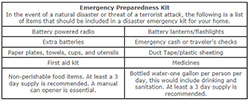
Emergency Preparedness Kit
In the event of a natural disaster or threat of a terrorist attack, the following is a list of items that should be included in a disaster emergency kit for your home. |
| Battery powered radio |
Battery lanterns/flashlights |
| Extra batteries |
Emergency cash or traveler's checks |
| Paper plates, towels, cups, and utensils |
Duct Tape/plastic sheeting |
| First aid kit |
Medicines |
| Non-perishable food items. At least a 3 day supply is recommended. A manual can opener is essential. |
Bottled water-one gallon per person per day, this would include drinking and sanitation. At least a 3 day supply is recommended. |
Remember family pets. In the event of emergency, they will also need water and food.
Storing extra blankets and extra clothing in a convenient dry place is a priority during cold winter months. If electricity is turned off, it is safe to assume that your furnace will not run. |