|
Thawing Fish | Salmon Preparation | Tips
Thawing Fish
Frozen fish can be cooked without thawing but the cooking time would need to be increased to cook it thoroughly. If the fish is going to be breaded, stuffed, broiled, fried or cooked in the microwave, it should be thawed completely first. There are several methods that can be used for thawing fresh frozen fish. Fish should never be thawed out at room temperature because the warm temperatures would allow bacteria to grow. Use one of the methods described below.
Refrigerator -
Thawing Time: 6 to 24 hours, depending on quantity. Generally, 6 to 8 hours per pound. |
(Recommended Method) Thawing fish in the refrigerator is the slowest but safest method you can use. The temperature of the refrigerator should be maintained at 35°F to 40°F to discourage growth of harmful organisms as the fish thaws.
Thaw Fish Not Frozen in Ice: Leave the fish wrapped and place on a platter or a tray to catch the drippings as it thaws. Place in the refrigerator to thaw.
Thaw Fish Frozen in Block of Ice: Remove the fish from the wrapper and place under cold running water to remove the ice surrounding the fish. Once the fish is free of ice, separate the pieces and place on a platter or in pan lined with paper towels. Cover tightly with plastic wrap and allow it to finish thawing in the refrigerator. |
Cold Water
Thawing Time: 1 to 2 hour per pound |
Thawing the fish in cold water is a faster method than thawing in the refrigerator, but the proper precautions must be taken when using this thawing method. Fill the sink or a large bowl with enough cold tap water to cover the fish. Place the fish in a sealable bag and place the bag in the cold water. The water should be changed every 30 minutes. Do not use warm water, even though it will thaw the fish faster, it will also cause the growth of bacteria. Once the fish is thawed, it should be cooked immediately.
If using the sink, do not use it for other purposes during thawing period and be sure the thawing water does not splash onto other preparation surfaces or food. Once the fish is thawed, remove it from the sink and clean all utensils and surfaces affected during the thawing period with hot water and soap. |
Microwave
See manual for defrosting times |
Thawing fish in a microwave is a quick method but is not recommended because of the difficulty in getting the different thicknesses to defrost evenly. Defrosting times vary according to different microwaves and according to the form of fish (whole or pieces) you are thawing. Use the steps below for thawing in the microwave:
- Place the fish on a microwave rack in a microwave safe pan. Place foil just on the tips of the pieces to protect from cooking.
- Microwave for 1/2 the defrosting time. See time chart below. Then turn the pieces over. Place on the rack so the thinnest sections are towards the middle and are overlapping each other. Remove foil from tips.
- Finish microwaving. Pieces should still be pliable and still cool to the touch. They may be slightly icy but they will finish thawing while they stand for 5 minutes.
|
Note - Microwaving with Aluminum Foil: Before using foil in the microwave oven, refer to the user manual for that oven to see what is recommended. Some models are manufactured so that the magnetron tube is protected, which allows small amounts of metal, such as aluminum foil and metal skewers to be used. Do not use foil if the manufacturer does not recommend use.
Care must be taken when using foil in the microwave. Use only thin strips or small pieces that are just large enough to cover the areas that need protection from overcooking. The foil pieces must be kept at 1 inch from the oven walls and 1 inch from each other. |
Note: If the individual fish pieces are frozen together, defrost in microwave just long enough to be able to separate the pieces and then follow directions above.
|
Defrosting Times
Using Defrost Feature or at 50% Power Level |
| Fish |
Thickness |
Frozen-No Ice |
Glazed |
| Minutes per lb. |
| Whole-Small |
1" - 1 3/4" |
3 1/2 -6 1/2 |
4 - 6 1/2 |
| Fillets |
1/4" - 1" |
3 - 5 |
3 1/2 - 5 1/2 |
| Steaks |
1" |
3 - 5 1/2 |
3 1/2 - 6 | |
Other Thawing Guidelines
- Never thaw fish at room temperature.
- Thawed fish should be cooked as soon as possible. If not using immediately, store in the refrigerator and use within 24 hours of thawing.
- Do not refreeze thawed fish.
- It is safe to refreeze fish once it has been cooked but some of its quality will be lost.
Salmon Preparation for Grilling
Fillets and Steaks
- Keep salmon refrigerated until ready to grill.
|
 |
|
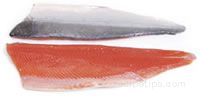
- Keep salmon skin intact while grilling. The skin will prevent the salmon from curling up and flaking apart. The skin is easily removed after grilling.
|
- Brush salmon and grill grate with a thin coat of cooking oil to prevent sticking on the grill. Oil the grill grate before starting the grill.
- If using a grill basket, oil the basket as well.
|
Whole Fish
The directions below use herbs and lemon for flavoring but the seasoning can be varied according to your taste.
- Store the salmon on ice or in the refrigerator until ready to cook.
- Rinse the salmon inside and out under cool water to remove any stray scales or bones.
- Pat the salmon dry with paper towels.
- The body cavity of the fish can be filled with fresh herbs and lemon slices if desired.
- Close the body cavity of the fish and tie with butchers twine.
- Score 3 diagonal cuts on both sides of the fish.
- Brush the whole fish (including the head) and the grill grate with a thin coat of cooking oil to prevent the salmon from sticking. Oil the grill grate before starting the grill.
- If using a grill basket, oil the basket as well.
Preparation Tips:
- Thaw frozen fish in milk to help remove the frozen taste and provide for a fresh fish flavor.
- To remove pin bones from a fillet of fish, lay the fillet, bone side up, across an inverted mixing bowl. The curve of the bowl will cause the bones to stick out, making them easy to find. Use a needle-nose pliers to pull the bones out.
- After cleaning fish or working with it on a cutting board, wash with hot soapy water and periodically cleaned with a bleach solution. Get rid of the fish smells by cutting a lemon or lime in half and rubbing the board down with it.
|