
|
|
| back to Glossary Index |
 |
|
|
 |
|
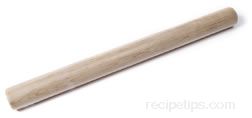
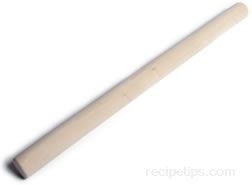
A wooden rolling pin, which is used to prepare dough for baking, that does not have handles. This kitchen utensil is most often made from tight-grained hardwoods such as boxwood or beech wood. The term "French Pin" is generally given to one of two types of pins, either a tapered or a straight French pin.
The tapered rolling pin may decrease in diameter from the center to the outer edges or it be tapered only on the ends with uniform diameter across the center section. Since it is formed across the grain of the wood, the surface will be slightly rougher than the straight French pin. Tapered pins are approximately 18 inches in length and are traditionally used to roll out circles of dough for pastries or croissants as the pin easily pivots on center enabling the pin to apply pressure wherever necessary to keep the dough uniforn in thickness. However, when using the tapered pin there can also be a tendency to create low and high spots in the dough because of the taper, so care must be taken to keep the dough uniform in thickness. The pins that taper to the center are often used to roll out thin crusts, allowing the pin to be easily rotated on the center section as the crust is rolled to a very minimal depth.
Straight French pins are commonly used for rolling larger amounts of bread or pastry dough. This pin has two blunt ends that may at times be used to crush or compress ingredients being mixed into the dough or when the dough is cold and less workable. However, it is best not to use either type of pin for crushing ingredients that may cause the surface of the pin to dent.
Both pins are well balanced and are usually preferred by those who like to have a closer touch between the hand and the dough, getting a tighter grip for a heavier touch or allowing a lighter touch when softer rolling is needed. This preference allows dough to be prepared in a manner that works the various dough textures fully and more effectively for the baker. When cleaning the surface of the pins, do not bathe the pin in great amounts of water, which only serves to add unnecessary moisture to the wood. Instead, use a damp cloth or a dough scraper to remove unwanted materials.
|
 |
 Straight French Pin |  |  Tapered French Pin |
|
 |
|
 |
French Rolling Pin term - Related Content |
 |
 |
 |
 |
 |
|
 |
 |
 |
|
 |
| This unbeatable classic American sandwich, named for the French bread it is prepared with, can be served au jus (French for “with juice”) or with a creamy homemade horseradish sauce. |
|
 |
 |
 |
|
 |
 |
 |
|
 |
| Make fun cutout cookies with this rolled out sugar cookie recipe. Shapes cut out easily and are fun for kids and adults to decorate for any holiday. |
|
 |
 |
 |
|
 |
| A beautiful dessert with great apple flavor. |
|
 |
 |
 |
|
 |
| Crispy and flavorful, fried onion rings make a great appetizer or a late evening snack. |
|
 |
|
|
 |
 |
 |
 |
 |
|
 |
|
|
 |
|
 |
|
Many rolls and buns are smaller versions of larger bread loaves. Others are formed into distinctive shapes that are used as single servings. Most of the shapes used for ... |
|
 |
|
|
 |
 |
 |
 |
 |
|
 |
|
|
 |
|
 |
| A long cylindrical shaped kitchen utensil, generally used to roll out various types of dough when making food items such as bread, pastries and cookies. This tool also works well ... |
|
 |
|
|
 |
|
 |
| A kitchen utensil that is used to mark out a sheet of pasta dough when making stuffed pasta squares. This rolling pin has indentations around the pin shaft that match the size of ... |
|
 |
 |
 |
|
 |
| A kitchen utensil that is used to flatten softened candy into sheets prior to hardening. This pin is typically made of stainless steel, providing a non-stick surface for candy ... |
|
 |
 |
 |
|
 |
| A hardwood rolling pin that is used for the single purpose of making Springerle cookies. The shaft of the pin is embossed with symbols that are separated by parallel grooves ... |
|
 |
 |
 |
|
 |
| A type of hardwood rolling pin that has evenly spaced raised protrusions extending out from the surface of the pin. The raised surface makes an embossed texture in the dough when ... |
|
 |
|
|
 |
 |
 |
 |
|
|
 |
|
|
|
|
|
|
|
|
 |
|
| Reproduction in whole or in part without written permission is strictly prohibited. |
| © Copyright 2008 Tecstra Systems, All Rights Reserved, RecipeTips.Com |
|
|
 |
|