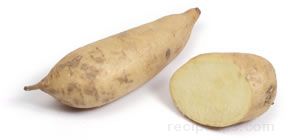

Sweet Potato

A tuber vegetable originating from Central America that is typically referred to as either a Sweet Potato or yam in the U.S. It is common for food stores to display and people to refer to the Sweet Potato as a yam, when it is actually a Sweet Potato. In the U.S. the term yam or Sweet Potato will generally refer to the orange-fleshed Sweet Potato that may be labeled as a Louisiana Yam. For marketing purposes, several Louisana varieties such as the Red Garnet were labeled as yams to distinguish them from other varieties of Sweet Potatoes. Outside of the U.S., a yam is not a Sweet Potato, but instead an actual vine-growing tuber that is more moist than a Sweet Potato. When the Sweet Potato is referenced outside of the U.S. it is either the white or yellow-fleshed variety. Sweet Potatoes are one of the best sources of beta-carotene, and are also a good source of fiber and vitamin C.

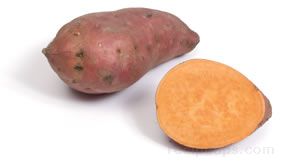
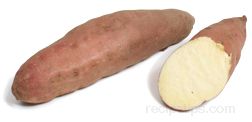
The true Sweet Potato has a shape that is often elongated and tapered at each end, or somewhat oval with a rounded end. The yam however, is typically a rougher skinned vegetable that may be either long and cylindrical with a tapered end or short and round in shape. Yams are often sold as chunks of tuber that may be irregularly shaped rather than fully formed.

Sweet Potatoes are often classified according to the color of their flesh; yellow, orange, white, or purple. The yellow, white and purple-fleshed tubers are most often marketed as a sweet potato while the orange-fleshed varieties are marketed as yams. Some of the common varieties of orange-fleshed Sweet Potatoes include, Beauregard, Golden, Jewel, and Red Garnet. Typically, the Beauregard is the variety most readily available in stores. The common varieties of the white Sweet Potato (boniato in Spanish) include Batata (Batata Dulce, Cuban Sweet, or Camote), Japanese Sweet (Japanese yam, Satsuma Imo, Kotobuki, or Satsumaimo), Yellow Jersey, and White Sweet. The Japanese Sweet Potato and the Japanese Yamaimo (Mountain Yam) are two different tubers which should not be confused. With a outer skin color similar to a baking potato (light tan), the Yamaimo differs in appearance from the reddish-pink skin coloring of the Japanese Sweet. The Japanese Yamaimo is considered to be a sticky, mountain yam which is the variety often used to make soba noodles while the Japanese Sweet is more dense than the yam and low in moisture content. When prepared, the Japanese Sweet is a good potato to cube and roast or stir-fry as it cooks well with faster cooking methods on a higher heat setting. The Okinawa or Okinawan is a purple-fleshed variety that is not as readily available. Covered by a thin, pale tan colored outer skin, this potato provides an enjoyable buttery and nut-like flavor. The Okinawan is also known as Tumai Kuru, Beni Imo, Ube or the purple yam. Yellow Jersey potatoes may be slightly more fiberous than other varieties and not quite as sweet in flavor.

In Australia, the Sweet Potato is referred to as the Kumara which is sold as a red, gold or orange Sweet Potato. The red Kumara has a red outer skin with white inner flesh, while the gold Kumara has a light brown skin covering a tan to grey-white flesh. The orange Kumara, which is similar in appearance to Beauregard, Jewel, or Red Garnet, has an orange to red outer skin with an orange colored inner flesh.

The orange or sweet varieties of the Sweet Potato are generally uniform in color throughout the flesh which can appear pinkish, orange, brown, or purple in color with a rich or sweet tasting flavor. The white or yellow Sweet Potato may have an irregular light pale yellowish color or darker pale reddish-orange hues with a creamy, but drier texture that is not nearly as sweet or moist as the orange-fleshed variety. As a general rule, the potato will be drier textured and less sweet as the color of the flesh lightens.

After Sweet Potatoes are removed from the ground, a grower will typically cure the potatoes in a storage area that is maintained at 80ºF to 85ºF with humidity in the range of 85%. As the potatoes cure in this environment, their maltose enzymes begin to increase the sugar content within the potato flesh which is what provides the sweet flavor in the potato flesh when baked. After proper curing the potatoes are ready for market. Select potatoes that are firm and small to medium in size, avoiding those that have shriveled skins, soft spots, or blemishes. After being selected, Sweet Potatoes should be stored in a cool, dark, and dry area with a temperature range of 50ºF to 60°F which will allow the potatoes to be stored for 3 to 4 weeks if necessary. Otherwise, use within a week. Do not store in the refrigerator where low temperatures such as 40ºF will adversely affect the potatoes and may convert the sugars to starch, which will cause a bad flavor and a hardened core to develop within the potato. Also, storing in the refrigerator will have a tendency to increase the chance of deterioration and decay resulting in a potato that will become overly mushy when cooked.

Sweet Potatoes go well with meat, poultry, fish and seafood. They can also be added to casseroles, soups and stews to enhance the flavors of other ingredients. In addition, Sweet Potatoes can be served as an ingredient for salads, pies, cookies, cakes, puddings, and custards. The sweet flavor of this vegetable can complement a variety of other sweet flavored vegetables such as carrots, rutabagas and parsnips.

Sweet Potato Glossary Term
White Sweet Potato
Sweet Potato Glossary Term
Beauregard Sweet Potato
Sweet Potato Glossary Term
Red Garnet Sweet Potato
Sweet Potato Glossary Term
Jewel Sweet Potato
Sweet Potato Glossary Term
Okinawan Sweet Potato
Sweet Potato Glossary Term
Hannah Sweet Potato
Sweet Potato Glossary Term
Japanese Sweet Potato
Sweet Potato Glossary Term
Golden Sweet Potato
Sweet Potato Glossary Term
Jersey Sweet Potato

USDA Nutrition Facts

Serving Size1 cup, cubes
Calories96
Protein1g
Total Fat0g
Total Carbohydrates22g
Dietary Fiber1g
Potassium365mg
Sodium6mg
Cholesterol0mg
Serving Size1 cup
Calories101
Protein1g
Total Fat0g
Total Carbohydrates23g
Dietary Fiber1g
Sugars5g
Potassium210mg
Sodium75mg
Cholesterol0mg
Serving Size1 cup, cubes
Calories86
Protein1g
Total Fat5g
Total Carbohydrates20g
Dietary Fiber3g
Sugars4g
Potassium337mg
Sodium55mg
Cholesterol0mg

Ratings, Reviews & Comments

There currently aren't any reviews or comments for this term. Be the first!

Sweet Potato Glossary Term - Related Content

Collections
View our collection of potato recipes.
Try sweet potatoes in place of the regular russets to change things up.
We have enough salmon recipes we're sure you'll find at least one you will love.
We have many seafood recipes that you're sure to enjoy.
With our selection of vegetarian recipes you won't even notice what's missing.
Entertain your guests with one of these prime rib recipes.
Recipes
Ingredients included in this recipe are sweet potatoes (large), eggs, Brown Sugar, butter, evaporated milk, cinnamon, nutmeg, ground cloves, allspice, vanilla, Salt.
Ingredients included in this recipe are sweet potatoes (medium), sugar, Cinnamon and Nutmeg, to taste.
Ingredients included in this recipe are sweet potatoes (medium), Vegetable oil spray, acceptable margarine, orange juice, chopped walnuts.
Ingredients included in this recipe are sweet potatoes, fat-free half and half, maple syrup, vanilla extract, salt, egg - lightly beaten (large), Cooking spray, flour, packed ...
Ingredients included in this recipe are margarine, pareve, onion, finely chopped, sweet potatoes, grated, carrots, grated (large), parsnips, grated (large), apple, peeled, cored, ...
Ingredients included in this recipe are mashed canned yams (3/4 large cans - drained), sugar, Eggs, vanilla, butter, melted, crushed pineapple, drained (small can), Topping, ...
Ingredients included in this recipe are CRUST, matzo meal, melted parve margarine, sugar, cinnamon, unsweetened coconut flakes (optional), Filling, cooked, mashed sweet potatoes, ...
Cooking Tips & Advice
Sweet Potatoes A tuber vegetable originating from Central America that is typically referred to as either a Sweet Potato or yam in the U.S. It is common for food stores to display and people to refer to the Sweet Potato as a yam, when it is actually a Sweet Potato.
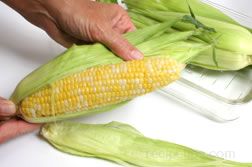
If you've never cooked corn on the cob on the grill, you don't know what you're missing. Get started by watching this video demonstration, which shows you one of the numerous methods for grilling sweet corn.
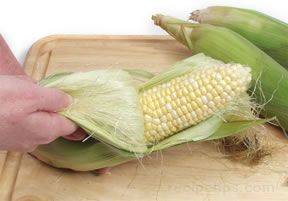
Husks On | Husks Off Grilling is a great way to cook sweet corn to give it a little different flavor from other methods of cooking. There are several methods that can be used when grilling sweet corn and you can experiment with different flavored butters or seasonings to also give the corn a unique flavor.
Sweet Corn Preparation | Cooking Corn on the Cob | Grilling Sweet CornCreamed Corn | Freezing Sweet Corn | Tips Sweet Corn Corn is a tall cereal plant consisting of strong jointed stems supporting large ears containing kernels.
Glossary Terms
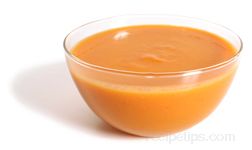
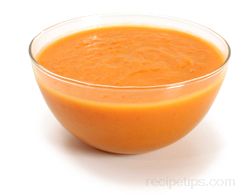
A milk and/or broth-based soup made from the flesh of orange Sweet Potatoes. Typically, this soup contains bits of onion and garlic cooked in a chicken broth that is mixed with milk, yogurt or half-and-half as a base.
The combination of sweet and fresh flavors creates a thick and savory soup made from a mix of vegetables and sweet potatoes.
The Japanese Sweet, which may also be referred to as a Japanese yam, an Oriental, Kotobuki, Satsuma Imo, or Satsumaimo, is a variety of potato that is common in Japan and is now grown in the U.
A type of vegetable considered to be a pumpkin and squash heirloom variety that is often used as a decorative squash rather than an eating squash.
Made in the same manner as a fried potato chip, Sweet Potato chips are thin, curled or flat in shape, and crunchy-textured.
A variety of sweet potato that has light colored skin and lavender flesh and is of Japanese and Chinese origin.
A speciality flour that is produced from white sweet potatoes. It is raw flour, not roasted flour and therefore, does not require cooking before use.
Enter and View Your Recipes
Advertisement
Reproduction in whole or in part without written permission is strictly prohibited.
© Copyright 2012 Tecstra Systems, All Rights Reserved, RecipeTips.com