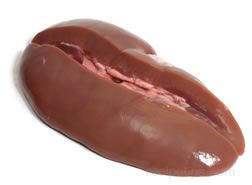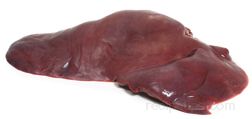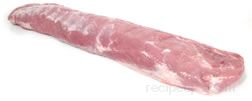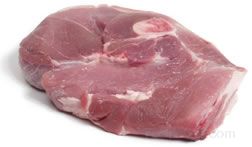



Even though pork is generally white in color when cooked, it is still considered "red meat" because it contains higher levels of a protein called myoglobin than actual white meat of chicken or fish. The quantity of myoglobin contained in meat is the factor that determines color. Like beef, lamb, and veal, pork is also classified as "livestock" and all livestock is categorized as "red meat."
Pork can be labeled, "natural", if it complies with the USDA standards for natural processing, handling and labeling. The standards stipulate that the product cannot contain artificial ingredients, artificial coloring, or chemical preservatives, and it cannot undergo extensive processing.
Pork labeled, "organic", must be produced and processed according to the specifications established in the USDA's Organic Standards. The standards prohibit synthetic input in all processes of pork production and meat processing and handling. Producers and processors must receive certification from a government-approved inspector.
The state or federal government inspects all retail cuts of pork. This inspection is mandatory and is performed by the Food Safety and Inspection Service of the USDA. The FSIS-USDA inspector checks the meat at all stages of processing including the slaughtering process, butchering, application of food additives, and labeling. All meat products, ranging from the whole carcass to the edible byproducts, must have the inspection legend seal stamped on the product or displayed on its label, which ensures that the product is wholesome, disease-free, and that it has been processed under sanitary conditions.
Pork is much leaner today than it was years ago. It contains 35% to 50% less fat so it usually is not a problem finding lean cuts in most food stores. When selecting pork cuts, the color of most cuts should be pink with a white to grayish tint and have a fine-grained texture. Meat from the loin is generally lighter in color than the meat from the shoulder or leg. The meat should be firm to the touch, look moist but not slimy wet, and it should not emit any foul odors. The fat on the outer edges should be creamy white and be blemish free. If the fat has a yellowish tint, it is an indicator that the meat is old and is nearing spoilage. The package containing the meat should be cool to the touch and free of any holes or tears.
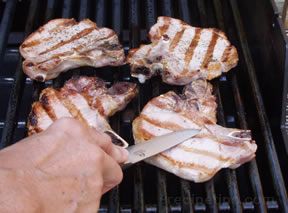
Leaner pork also affects the techniques used for cooking pork. Because there is less fat to moisten and to add flavor to the meat, care should be taken to not overcook pork. There are various cooking methods that can be used to produce juicy and flavorful pork. Some methods work better than others on different cuts of meat. Dry heat cooking methods, such as roasting, broiling, grilling, and pan-frying, are most often used on cuts that are naturally tender, such as bacon, chops, steaks, loin roasts, and tenderloins. Moist heat cooking methods, such as braising, stewing, and steaming are most often used on cuts that are less tender, such as ribs, shoulder cubes and boneless Boston butt roasts.
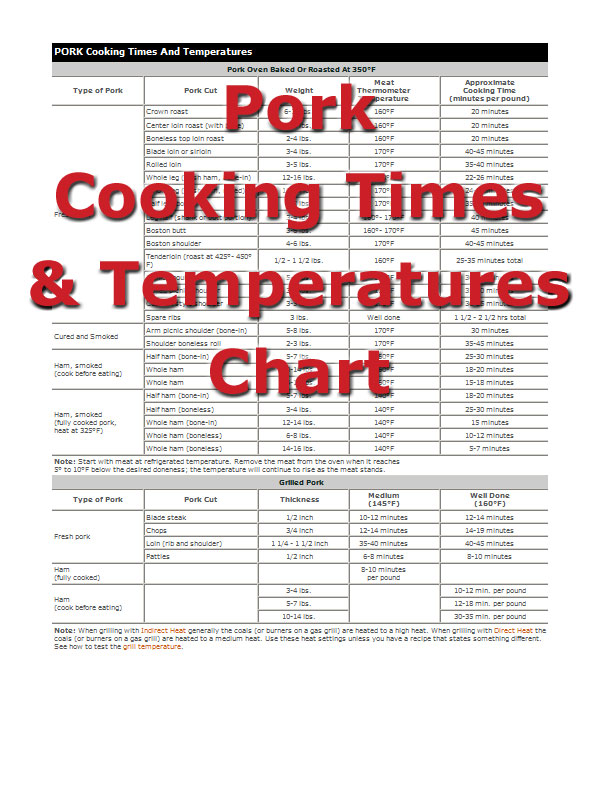
It was once thought that pork must be cooked to an internal temperature of 185°F to ensure that trichinella spiralis parasite, which is sometimes present in pork, would be killed. It is now known that trichinella spiralis is eliminated at 137°F, however, it is still recommended that pork be cooked to an internal temperature of 155°F to 160°F to ensure safety. Cooking the pork to a temperature of 185°F produces tough, dry meat. An accurate meat thermometer is the best tool for ensuring that meat has cooked to the proper internal temperature.
Pork should be stored in conditions that do not allow the meat to be exposed to temperatures ranging between 40°F and 140°F, which is the danger zone for bacterial growth. The bacteria that causes food borne illness multiply rapidly in this temperature range, so it is important to keep cold foods cold and hot foods hot. Raw pork can be stored in a refrigerator several days, depending on the type of cut. If it is not to be used within the recommended time, it should be frozen to prevent it from perishing. Leftover cooked pork should be wrapped tightly and refrigerated as soon as possible. Do not leave any pork at room temperature for more than two hours. If cooked pork is not going to be used within four days of cooking, it should be frozen.
Raw pork should be stored in the refrigerator at 40°F or lower and should be used within three to five days of the "sell by" date on the package or it should be frozen. Freezing should be avoided if possible because it will cause the pork to be less tender and juicy but, if it will not be used within the three to five day refrigerator storage time, it should be frozen to prevent it from perishing. Freezing meat has little affect on its nutritional value. When freezing, the pork should be placed in the freezer compartment while it is as fresh as possible in order to maintain the best quality. To maintain maximum quality, bacon and sausage should be used within one to two months, ground pork within three months, and roasts, chops, and steaks within six months.
Pork is a nutrient dense food, meaning that its nutrient level is high in proportion to its calorie content. Pork contains a high level of some of the essential B vitamins, such as B12, B6, thiamin, niacin, and riboflavin. It is also rich in other nutrients, such as phosphorous, zinc, potassium, iron, and magnesium. One 3-ounce portion of pork provides approximately half of the daily requirement of protein.