
Loading
Search
We hope you found what you are searching for. If not, contact us and let us know what your want. We will do the work for you and get back to you when we're done.
straight edge blade - Glossary Search
Top 21 glossary terms found
Displaying 1-20 | Next 1 >>
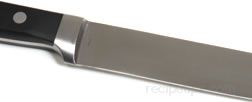
A knife blade that is straight along the cutting edge or straight and slightly curved. In contrast, blades that contain serrations such as serrated blades or indentations such as hollow edge blades are not considered to be straight-edged blades.
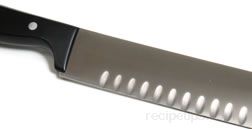
A term used to describe a knife blade which most often contains evenly spaced vertical indentations or "hollows" that have been ground out of the thickness of the steel blade.
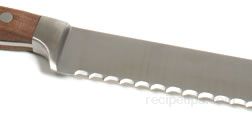
A sharp-edged blade with saw-like notches or teeth formed into one side of the blade surface that enable it to slice cleanly through foods without damaging delicate or soft textures, such as bread or pie crusts.
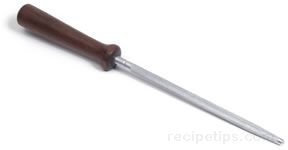
A tool that is used to continually keep edges of knife blades straight to maintain a sharp edge after each use.
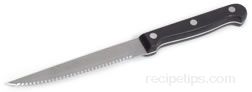
A knife used for cutting foods served as a main course such as steak and chicken. The knife usually has a blade that is 4 to 6 inches long and varies in thickness.
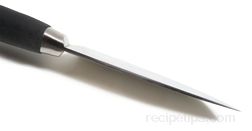
The blade of a knife that decreases in size from the handle to the tip and from the top or spine of the knife to the bottom or cutting edge of the blade.
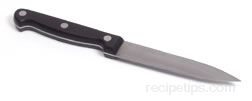
A small lightweight knife, which usually has a blade that is 4 to 7 inches long and is used for miscellaneous light cutting.
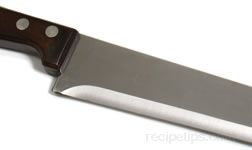
A knife blade with concave beveled edges created by starting midway or lower from the top of the blade and grinding or tapering each side of the blade thinner toward the bottom or cutting edge by grinding a inward curvature.
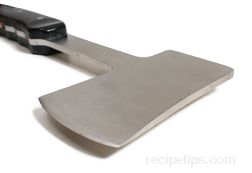
The opposite of a hollow-ground blade, this type of knife blade rounds outward instead of inward such as a hollow grind.
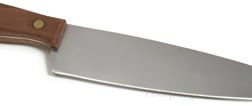
The type of blade with a straight "V" cut ground into the steel edge. Varying in depth, the Flat Ground Blade can be made with only as very slight "V" cut or a longer cut that tapers slightly from higher up on the blade and extends downward toward the cutting edge.
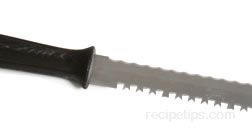
Some blades built to handle hardened objects such as frozen foods are formed with an alternating blade construction containing sets of double-toothed blade extensions separated by curved and serrated blade surfaces.
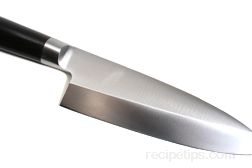
With a ground edge that looks like the blade of a chisel and thus the origin of its name, this type of blade has a grind that is made on only one side of the blade.
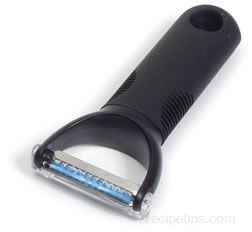
A kitchen utensil made to simplify the process of making julienne strips used for decorative garnishes.
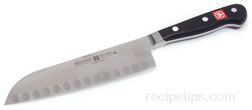
A type of knife commonly used to prepare ingredients for Asian food dishes. This knife, which is also known as an Asian cook's or chef's knife, is very similar to a traditional chef's knife with a wide blade that has a long straight edge curving up slightly at the end.
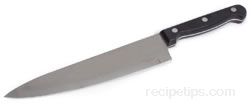
A utensil that has a handle and a blade that may or may not be sharp-edged. Available in a wide variety of different types and sizes, a knife is used for cutting, chopping, dicing, slicing, mincing, peeling, separating, and other kitchen tasks where the thin metal shaft of a blade is of value for food preparation.
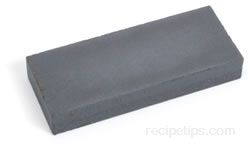
A kitchen tool designed to remove cleanly file or hone the cutting edges on the steel blades of knives and other utensils with cutting edges.
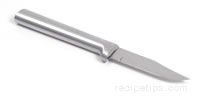
Traditionally, this utensil is a small knife with a straight, sharp blade that is generally three to five inches long and rounded on the cutting side.
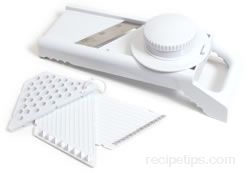
A hand-operated appliance used for cutting and slicing fruits and vegetables. This kitchen utensil has a variety of adjustable blades that enable the Mandoline to make precise cuts in firm fruits and vegetables, such as apples, melons, carrots, cucumbers, eggplants, onions, potatoes, sweet peppers, zucchini, and other foods.
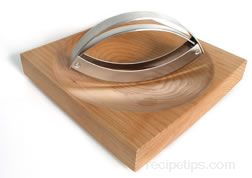
A wooden utensil made from a hardwood such as maple that is used as a chopping or cutting surface when preparing delicate and small ingredients, such as fresh herbs.
A finishing tool that is used sharpen (hone) the steel blades of knives and cutting utensils such as scissors or garden utensils.
Top 21 glossary terms found
Displaying 1-20 | Next 1 >>


Advertisement
Advertisement