
Loading
Search
We hope you found what you are searching for. If not, contact us and let us know what your want. We will do the work for you and get back to you when we're done.
reduce - Glossary Search
Top 176 glossary terms found
Displaying 1-20 | Next 20 >>
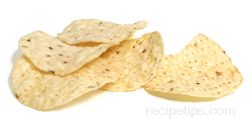
A term referring to foods in which the sodium content has been reduced. Reduced Sodium foods are important for individuals that have been placed on low sodium diets due to medical concerns, as too much sodium in the diet can lead to high blood pressure for some people.
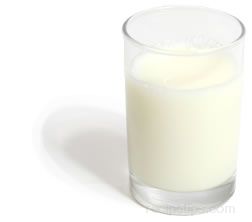
Milk containing 2% percent milk fat. Many consider low-fat milks containing 1% or less of milk fat such as 1% low-fat milk or skim milk to be reduced-fat milks however, the actual classification for a reduced-fat milk is the variety labeled "2% reduced-fat" milk.

To thicken and intensify the flavor of a liquid by rapidly boiling the contents in an uncovered pan in order to evaporate excess liquid.
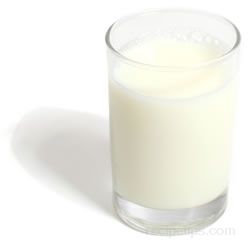
A type of milk that contains a low amount of lactose or is free of lactose. Typically, milk with reduced lactose has been fortified with lactase, an enzyme used to break down the lactose (sugars) in the milk making it easier to digest for individuals considered lactose intolerant.
In reference to wine making, "reducing conditions" are the conditions that promote reduction (non-contact with oxygen).
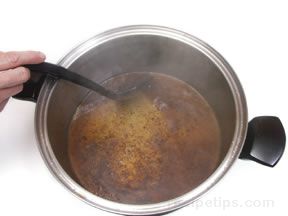
The process of loosening, reducing, and dissolving the residue remaining in a pan after meat has been sautéed.
A thick syrupy sauce created by reducing caramelized sugar and wine or vinegar. A wine vinegar could also be used.
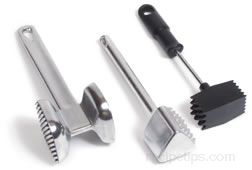
Tools used to reduce the toughness of meat fibers in a cut of meat. The tools resemble a hammer-like utensil typically made of steel or similar alloys.
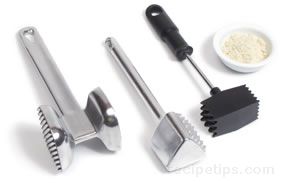
A process to reduce the toughness of meat fibers in a cut of meat. Tenderizing breaks down the meat fibers and softens the meat, making it easier to chew and more palatable.
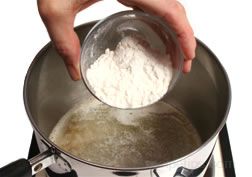
To create a denser liquid or mixture by either adding a thickening agent or by boiling to reduce the existing volume of liquid.
A process that bathes food with low level gamma rays (x-rays) or electron beams (e-beam) to reduce or kill microorganisms, such as e-coli, listeria, salmonella and campylobacter that may cause illnesses from exposure to harmful pathogens.
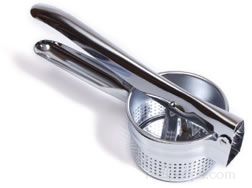
A kitchen utensil used to reduce whole soft foods, such as cooked potatoes and carrots into smaller bits.
A kitchen utensil used to reduce whole soft foods, such as cooked potatoes and carrots into smaller bits.
A gas used to preserve, remove impurities, and reduce the oxidation of wine.
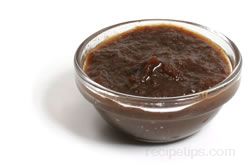
A variety of alternate ingredients that can be used instead of oil or butter in the preparation of foods.
A process that bathes food with low level gamma rays (x-rays) or an electron beam (e-beam) to reduce or kill microorganisms, such as e-coli, listeria, salmonella and campylobacter that may cause illnesses from exposure to harmful pathogens.
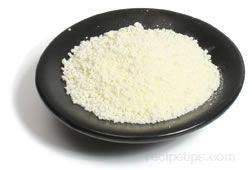
Milk that has had most of the water content removed, reducing it to a dry powder form. Dry whole milk must be refrigerated because its high fat content is susceptible to spoilage if not refrigerated.
Refers to the process of thinning a liquid by adding more liquid and/or reducing the flavor by adding liquid.
The trim pieces from foods that are suitable to use for other products, reducing the amount of overall waste.
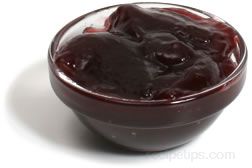
A thick fruit spread made with fruit pieces and sugar that are cooked and reduced until thickened into a medium textured spread.
Top 176 glossary terms found
Displaying 1-20 | Next 20 >>


Advertisement
Advertisement