
Loading
Search
We hope you found what you are searching for. If not, contact us and let us know what your want. We will do the work for you and get back to you when we're done.
sauteing pork - Knowledge Search
Top 55 articles found
Displaying 21-40 | << Prev 20 | Next 15 >>

Pork producers today have significantly changed production methods to produce much leaner meat than 25 years ago. Better breeding and feeding of the hogs and a grading system that stimulates the meat packers to trim more of the external fat than they did in the past has resulted in leaner meat.
Frying is a dry heat cooking method, which is a quick and simple way of cooking pork. It can be accomplished by the use of two different methods, pan-frying and deep frying.
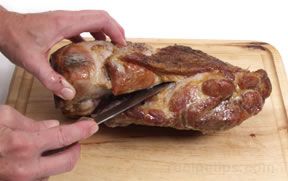
The larger pork cuts will need to be carved into smaller pieces for serving. Before carving, the meat should stand for 10 to 15 minutes after it is removed from the heat source.
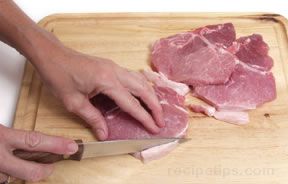
Fresh or thawed pork does not require rinsing before it is cooked because any bacteria on the surface of the meat will be destroyed during the cooking process. Chops and steaks sometimes benefit from being briefly rinsed in cold water to rinse away bone grindings that may occur when the chops and steaks are cut apart.
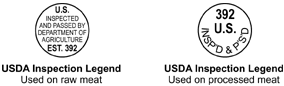
Tips on Selecting Cuts | Terms | Description of Cuts | Inspection and GradingRead the Label | Look and Feel | Quantity to Buy | Purchasing in Quantity
When shopping for pork there are several things that you need to consider so that you will be assured of purchasing the correct quantity, quality and type of pork to satisfy your needs.
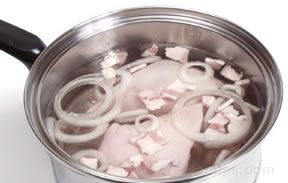
Poaching is a moist heat method of cooking. It is also a healthy method of cooking pork because no fat is added during the cooking process. It retains the flavor, tenderness and moisture through a gentle simmering process.
Steaming is a moist heat method of cooking. It results in tender and moist meat through the use of steam. When steaming meat, minimum shrinkage occurs, and it is one of the most healthy methods of cooking because no additional fat is used.
Shopping Tips | Thawing Tips | Refrigerating Tips | Freezing TipsHandling and Safety Tips | Marinating Tips | Stuffing Tips | Trimming & Slicing TipsChecking Doneness | Roasting Tips | Frying Tips | Grilling & Broiling TipsSteaming Tips | Stir-fry Tips | Tenderness Tips | Light Tips | Cooking Tips
Shopping Tips:
Decide how much time and effort you want to use in preparing and cooking the cut you select.
Tenderness Tips
Avoid freezing whenever possible to eliminate moisture loss that occurs during thawing. The moisture loss in thawing results in less tender meat.
Keep pork from drying out in the refrigerator by keeping it tightly wrapped.
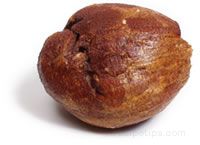
Hams
Hams are cuts of pork that come from the leg, which have been dry-cured and smoked (country hams) or wet-cured and then boiled or smoked (city hams). The dry-cured hams are saltier, stronger flavored and have a coarser texture.
There are numerous pork products available, consisting of fresh, frozen, cured, smoked, uncooked, fully cooked, and many heat-n-serve products. Some products are available breaded, seasoned or marinated.
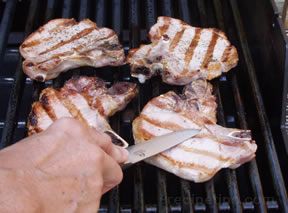
Grilling is a cooking method that uses a dry heat that quickly cooks the surface and then slowly moves to the middle of the meat. When grilled properly, the meat will have a crisp flavorful outside coating with a moist center. Grilling infuses the pork with a smoky flavor from the meat juices that drip during the grilling process.
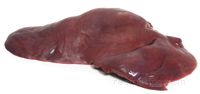
Variety Meats
The variety meats include the organs, glands and the extremities of the pig. The meats taken from younger pigs will be more tender and milder in flavor.
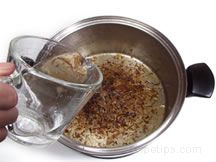
Braising and stewing are very similar moist heat methods of cooking. They both use the same process of searing to enhance color and flavor, and slow cooking in liquid to produce tender, moist meat.
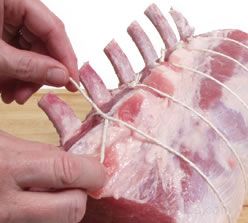
The process of tying meat is used to ensure even cooking and helps hold the shape of the cut. Tying is used on several different cuts and there are several styles of tying that can be used.
The first thing to do before starting any kind of trimming process is to be sure that the knives to be used are sharp. This will make the process go more smoothly. Dull knives are not safe and will produce poor cuts.
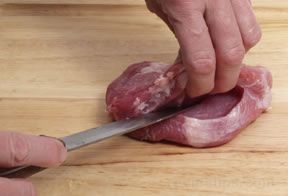
Stuffing can be used in crown roasts, extra thick chops or steaks, rolled roasts or rolled into flattened tenderloin. The stuffing can be made from a simple bread base or a wild rice mixture, with ingredients such as onions, garlic, lemon, herbs, and spices added for extra flavor.
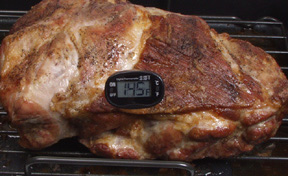
Checking doneness is accomplished in basically the same manner regardless of the cooking method you are using. While some methods are more accurate than others, there are certain cuts for which some methods will not be suitable.
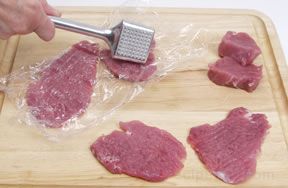
Pounding
Pounding of meat is performed for various purposes. Meat is pounded to tenderize, to even out the thickness of some cuts so that they cook more evenly, and to form cutlets.
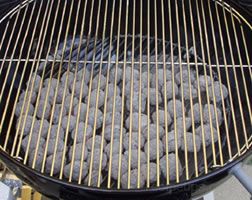
Direct
Indirect
Understanding the two most popular grilling styles, Direct and Indirect, is essential for creating a perfect grilled entrée. There are instances when both Direct and Indirect methods are appropriate.
Top 55 articles found
Displaying 21-40 | << Prev 20 | Next 15 >>


Advertisement
Advertisement