
Loading
Search
We hope you found what you are searching for. If not, contact us and let us know what your want. We will do the work for you and get back to you when we're done.
taper ground blade - Glossary Search
Top 7 glossary terms found
Displaying 1-7
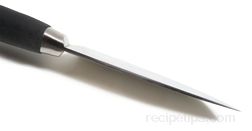
The blade of a knife that decreases in size from the handle to the tip and from the top or spine of the knife to the bottom or cutting edge of the blade.
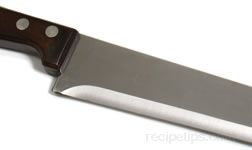
A knife blade with concave beveled edges created by starting midway or lower from the top of the blade and grinding or tapering each side of the blade thinner toward the bottom or cutting edge by grinding a inward curvature.
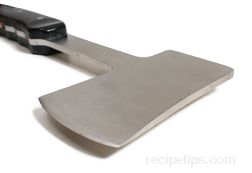
The opposite of a hollow-ground blade, this type of knife blade rounds outward instead of inward such as a hollow grind.
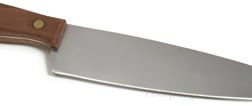
The type of blade with a straight "V" cut ground into the steel edge. Varying in depth, the Flat Ground Blade can be made with only as very slight "V" cut or a longer cut that tapers slightly from higher up on the blade and extends downward toward the cutting edge.
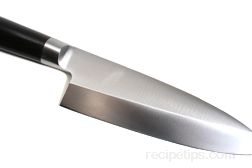
With a ground edge that looks like the blade of a chisel and thus the origin of its name, this type of blade has a grind that is made on only one side of the blade.
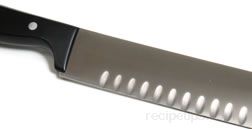
A term used to describe a knife blade which most often contains evenly spaced vertical indentations or "hollows" that have been ground out of the thickness of the steel blade.
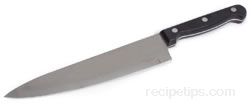
A utensil that has a handle and a blade that may or may not be sharp-edged. Available in a wide variety of different types and sizes, a knife is used for cutting, chopping, dicing, slicing, mincing, peeling, separating, and other kitchen tasks where the thin metal shaft of a blade is of value for food preparation.
Top 7 glossary terms found
Displaying 1-7


Advertisement
Advertisement