| Types of Edible Fats |
|
Sweet Butter
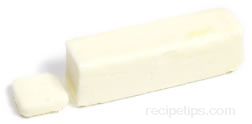 Sweet butter, which is simply referred to as "butter", is produced from cream that has been churned until it becomes semisolid. It is one of the two main types of butter (the other is lactic butter). Any type of milk can be used, but cow's milk is the most popular. In the United States, any product labeled sweet butter must contain at least 80% milk fat. Water and milk solids are the remaining components. Sweet butter, which is simply referred to as "butter", is produced from cream that has been churned until it becomes semisolid. It is one of the two main types of butter (the other is lactic butter). Any type of milk can be used, but cow's milk is the most popular. In the United States, any product labeled sweet butter must contain at least 80% milk fat. Water and milk solids are the remaining components.
Sweet butter may be sold salted or unsalted. Many people mistakenly believe that "unsalted butter" is the only type of sweet cream butter (because of the absence of salt) and "salted" butter refers to a product that is entirely different, when actually both products are identical except for the salt. Any butter produced with sweet rather than sour cream is known as sweet cream butter. Both unsalted and salted butter are popular for everyday use, but unsalted butter is preferred for the preparation of sweet dishes.
Butter is one of the most popular cooking fats, providing rich flavor to foods, but it has a low smoke point, so care must be taken not to burn it when using it for high heat sautéing and frying. When sautéing with butter, many cooks add an oil with a higher smoke point to prevent the butter from burning.
Butter is used as a topping for breads and rolls, is melted onto cooked vegetables, and is added to many types of sauces to provide a rich, smooth flavor. It is also used as an ingredient in hundreds of baked goods such as breads, rolls, cakes, and pastries.
| Note: A product labeled "whipped butter" is regular butter that has had air beaten into it in order to increase the volume and to make it easier to spread. It should not be used in baked goods because the large volume of air contained in the product will result in the incorrect proportion of butter in comparison to the other ingredients. |
Butter is inspected and graded by the United States Department of Agriculture (USDA). The flavor, color, texture, body, and salt are among the criteria used by the USDA for grading. The grade consists of a letter grade and sometimes a numerical score such as AA or a score of 93, which is the best. Other grades include A, or a 92 score, B, or a score of 90, and C, representing a score of 89. Usually only Grade AA and Grade A are found in food stores.
Butter is perishable so it should be stored in the refrigerator. It should be tightly wrapped because it will absorb odors and flavors quite easily. Unsalted butter may be kept in the refrigerator for 2 or 3 weeks and salted butter may be kept somewhat longer (4 or 5 weeks) because the salt acts as a preservative. Butter freezes extremely well and may be kept in the freezer for long-term storage for at least a half year.
Common Uses: cooking, baking, condiment, ingredient for sauces, flavoring ingredient |
| Lactic Butter
One of the two basic types of butter is lactic butter (the other main type is sweet cream butter), which is produced by adding a culture to pasteurized cream. The culture ripens the butter and at the appropriate time, it is pasteurized again to stop the ripening process. Lactic butter is favored in many European countries.
Common Uses: cooking, baking, condiment, ingredient for sauces, flavoring ingredient |
|
Clarified Butter
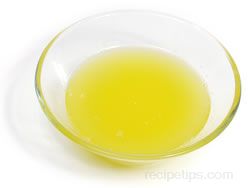 Clarified butter is produced by melting regular butter over low heat and skimming off the milk solids that rise to the top. The golden yellow clarified layer is then strained off, leaving only sediments in the bottom of the pan. Clarified butter has a rich buttery flavor and is excellent for cooking because it has a higher smoke point than regular butter. It is used in many baked dishes and for creating a variety of sauces. Clarified butter is also known as drawn butter and is often used as a dipping sauce for various types of seafood, such as shrimp and lobster. Clarified butter is produced by melting regular butter over low heat and skimming off the milk solids that rise to the top. The golden yellow clarified layer is then strained off, leaving only sediments in the bottom of the pan. Clarified butter has a rich buttery flavor and is excellent for cooking because it has a higher smoke point than regular butter. It is used in many baked dishes and for creating a variety of sauces. Clarified butter is also known as drawn butter and is often used as a dipping sauce for various types of seafood, such as shrimp and lobster.
Common Uses: ingredient in baked dishes and sauces, condiment |
|
Brown Butter
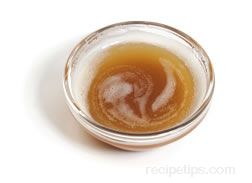 Brown butter is often used as a flavoring condiment for enhancing the taste of other foods. It is easily created by melting butter slowly so that the milk solids begin to brown, but not burn. As the butter is heated, it is transformed into a golden brown liquid with a nutty and complex flavor. If heated too long, it becomes dark and burned and takes on a very unpleasant odor and flavor. Brown butter is often used as a flavoring condiment for enhancing the taste of other foods. It is easily created by melting butter slowly so that the milk solids begin to brown, but not burn. As the butter is heated, it is transformed into a golden brown liquid with a nutty and complex flavor. If heated too long, it becomes dark and burned and takes on a very unpleasant odor and flavor.
Common Uses: flavoring condiment |
|
Ghee
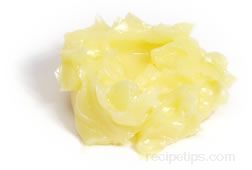 Originating in India, ghee is a form of clarified butter that is made from a strongly flavored cream. After the butter from the cream is clarified, it is allowed to remain on the heat for a longer period, which results in a darker, caramelized, strongly flavored butter. It has a very high smoke point, making it useful for high heat cooking methods. Ghee, which is usually sold in cans, does not have to be refrigerated because it contains no milk solids that can spoil. Originating in India, ghee is a form of clarified butter that is made from a strongly flavored cream. After the butter from the cream is clarified, it is allowed to remain on the heat for a longer period, which results in a darker, caramelized, strongly flavored butter. It has a very high smoke point, making it useful for high heat cooking methods. Ghee, which is usually sold in cans, does not have to be refrigerated because it contains no milk solids that can spoil.
Common Uses: cooking, ingredient in baked dishes and sauces, condiment |
|
Whey Butter
In order to produce whey butter, the whey is drained from the cheese curds during the cheese making process. Any cream remaining in the whey is separated and churned into butter. Whey butter is strong and salty with a cheese flavor and it has limited appeal. It can be found in some specialty shops and farmers markets.
Common Uses: condiment, flavoring ingredient |
|
Cocoa Butter
Cocoa butter is a cream colored vegetable fat that is obtained from cocoa beans, usually as a byproduct during the production of chocolate and cocoa powder. It is used as a flavoring for various foods and it is also used in the cosmetic industry for the manufacture of soaps and lotions. It is very high in saturated fat so it should be used sparingly.
Common Uses: chocolate and cocoa powder production, cosmetics |
|
Lard
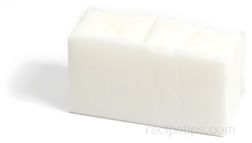 Lard is pork fat that has been rendered and clarified to produce a product that is firm and evenly textured with a mild flavor. Lard that is not processed has a soft, greasy texture and a strong flavor. Processing methods include bleaching, filtering, and hydrogenation. The fat around the kidneys produces lard with the best quality. At one time, lard was extremely popular as an all-purpose cooking fat and for use in baking. It has become much less popular because of the health problems associated with the overuse of saturated fat in the diet. However, it is still preferred by many pastry cooks because it produces the most tender and flaky crusts. Some cooks add butter to lard when making pastries in order to make the crust more flavorful. Lard is pork fat that has been rendered and clarified to produce a product that is firm and evenly textured with a mild flavor. Lard that is not processed has a soft, greasy texture and a strong flavor. Processing methods include bleaching, filtering, and hydrogenation. The fat around the kidneys produces lard with the best quality. At one time, lard was extremely popular as an all-purpose cooking fat and for use in baking. It has become much less popular because of the health problems associated with the overuse of saturated fat in the diet. However, it is still preferred by many pastry cooks because it produces the most tender and flaky crusts. Some cooks add butter to lard when making pastries in order to make the crust more flavorful.
Like butter, lard will absorb flavors and aromas so it should be tightly wrapped when it is stored. The label should be checked for the proper storage method because some types of lard, depending on the processing technique, may be stored at room temperature, while other types require refrigeration.
Common Uses: baking, frying |
|
Suet
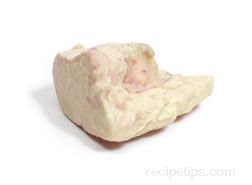 Suet is a white, solid fat obtained from the area surrounding the kidneys of beef and sheep. It is used for the creation of dumplings and for several traditional English steamed puddings, such as steak and kidney pudding. It is also used in the manufacture of tallow candles. It was very popular at one time, but it has lost much of its popularity due to increased awareness of health problems associated with saturated fat. Suet is sold in large chunks or in a shredded form in small packets. Suet is a white, solid fat obtained from the area surrounding the kidneys of beef and sheep. It is used for the creation of dumplings and for several traditional English steamed puddings, such as steak and kidney pudding. It is also used in the manufacture of tallow candles. It was very popular at one time, but it has lost much of its popularity due to increased awareness of health problems associated with saturated fat. Suet is sold in large chunks or in a shredded form in small packets.
Common Uses: steamed puddings, candles |
|
Vegetable Shortening
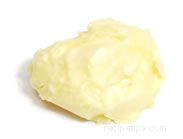 Made from vegetable oils, vegetable shortening is a solid fat at room temperature because of a process called hydrogenation in which hydrogen is added to the oils. This changes the chemical characteristics of the oils, making them solid at room temperature. The process also creates trans-fatty acids, which transforms the healthy oils, composed largely of unsaturated fat, into less healthy fats containing mostly saturated fat. Made from vegetable oils, vegetable shortening is a solid fat at room temperature because of a process called hydrogenation in which hydrogen is added to the oils. This changes the chemical characteristics of the oils, making them solid at room temperature. The process also creates trans-fatty acids, which transforms the healthy oils, composed largely of unsaturated fat, into less healthy fats containing mostly saturated fat.
Like lard, vegetable shortening is very useful in baking light and flaky pastries. Some varieties may have butter flavoring added, which improves the flavor and gives the shortening a light golden color. Vegetable shortening can be stored at room temperature for a year or more if it is tightly covered.
Common Uses: baking, frying
| Note: Most solid cooking fats can be called shortening because when they are used for baking, they produce a short, or flaky and crumbly crust. The more fat used in proportion to flour in a recipe, the shorter the crust. If the flour is in a greater proportion to the fat, the crust will be tougher and less flaky. | |
|
Margarine
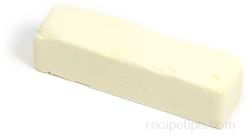 Margarine has been a popular butter substitute for over a hundred years. Like butter, regular margarine must contain a minimum of 80% fat. It is made from various vegetable oils such as soybean and corn. Margarine has been a popular butter substitute for over a hundred years. Like butter, regular margarine must contain a minimum of 80% fat. It is made from various vegetable oils such as soybean and corn.
In order to produce margarine in a solid form, the vegetable oil must undergo hydrogenation, which is a process that adds extra hydrogen to the oils. This process changes the chemical composition of the vegetable oils resulting in the oils becoming a solid at room temperature. The hydrogenation process also produces trans-fatty acids, which converts the healthy unsaturated fats of the vegetable oils into solid saturated fats. This characteristic makes many of the margarines on the market no better or worse than butter in terms of nutrition and health. When shopping for margarine, look for brands that are low in trans-fatty acids.
Margarine can be used similar to butter as a topping for bread, rolls, biscuits, or vegetables. It is much more spreadable than butter when used directly from the refrigerator. Margarine is often used in a variety of baked goods and can be used in any recipe requiring butter. It has a lower smoke point than many cooking oils and fats so it is usually not the first choice for sautéing or frying.
Other types of margarine include:
- Soft Margarine: formulated to be easy to spread.
- Whipped Margarine: beaten vigorously to add air to the mixture, which makes it very spreadable.
- Liquid Margarine: packaged in a squeezable bottle, making it easy to add to foods such as corn on the cob or for use as a basting medium.
- Reduced Fat Margarine: has as much as 65% less fat than regular margarine making it a healthier alternative, however because of the high water content, it is not as suitable for some baked goods as regular margarine and it isn't as useful for sautéing or frying.
- Fat-free Margarine: a much healthier spread than regular margarine when used as a condiment. It has a much higher water content than regular margarine so it should not be used for sautéing, frying, or baking.
Margarine should be stored in the refrigerator where it will keep for 2 months or more and for long term storage, it may be kept in the freezer for a half year or longer. Like butter and other solid fats, margarine will absorb the flavors and odors of other foods so it should be tightly wrapped or covered when storing.
Common Uses: cooking, baking, condiment | | |


