|
The Food Industry's Role | At-Home Safety Guidelines | More Information
 |
According to the Centers for Disease Control and Prevention (CDC), each year in the United States there are an estimated 76 million cases of foodborne illness. An estimated 325,000 of these cases lead to hospitalization and, for 5,000 people, the illness leads to death. The government defines foodborne illness as the result of eating food that is contaminated with harmful bacteria, viruses, parasites, or toxins. |
| Many cases of foodborne illness are preventable. Consumers can play a big part in prevention. Consumers as well as retail food preparers have a great deal of power to eliminate harmful bacteria with a few simple safety strategies. As the final handlers of food, they have control over how to store it, prepare it, cook it, and, most important, whether or not to eat it. |
| The Food Industry’s Role |
|
Food companies are dedicated to food safety, and rigorously monitor processes and test their products. In many cases, harmful bacteria enter food after the food has left the food processing plant—usually when consumers handle, store, and prepare the food improperly.
Consumers should always follow the food manufacturer’s cooking and storage instructions found on the product label. Many labels also tell if a product was pasteurized (heat treated) to kill harmful bacteria. |
|
At-Home Safety Guidelines |
|
In many cases, it is obvious when food is spoiled. If your food smells unusual, or if the container appears abnormal (swollen, leaking product), discard it immediately. If there is evidence of package tampering, discard the food immediately and report it to authorities. Make sure to refrigerate shelf-stable foods once you have opened them.
The Partnership for Food Safety Education, a coalition of industry, government, and trade groups, offers the following steps for keeping foods safe.
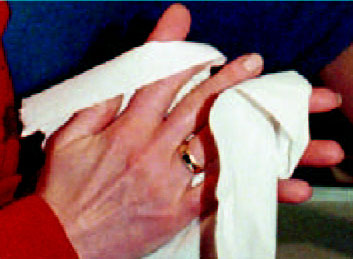
- Clean—Wash your hands in hot, soapy water for at least 20 seconds before preparing food, after using the bathroom, changing diapers, cleaning litter boxes, and handling pets. Wash cutting boards, surfaces, and utensils after preparing
each food item. Consider using paper towels rather than cloth to avoid spreading bacteria. |
- Separate—Most foodborne illness is caused by cross-contamination. Separate raw meat, poultry, and seafood (and their juices) from other foods. Store these items on the bottom shelf of your refrigerator so juices will not drip onto other foods. Use separate cutting boards for meats. Never place cooked food, including meat, on a surface that previously held raw meat.
|
 |
- Cook—Use a meat thermometer to make sure meat and poultry cook thoroughly. (Clean the thermometer after each use.) Avoid rare and medium-rare ground beef, which can harbor harmful bacteria. Always cook egg yolks and whites until firm. Cook fish until it flakes with a fork. Proper heating temperatures are 145°F (steak and roast), 160°F (ground beef), 165°F (soups, sauces, gravy, and leftovers), and 180°F (whole poultry).
- Chill—Experts recommend setting the refrigerator at 40°F and the freezer at 0°F. Remember to refrigerate leftovers within two hours after eating. Defrost and marinate foods in the refrigerator, not on the kitchen counter. Do not overstock your refrigerator. Overstocking keeps cold air from circulating to all the foods inside.
|
| More Information |
|
www.nfpa-food.org
(National Food Processors Association, NFPA)
www.safefood.org
(NFPA’s consumer website)
www.fightbac.org/main.cfm
(Partnership for Food Safety Education)
www.foodsafety.gov
(gateway to government food safety information)
www.nal.usda.gov/foodborne/index.html
(Foodborne Illness Education Information Center) |
Developed by the National Food Processors Association • www.nfpa-food.org |


