|
Sautéing | Pan-Frying | Deep-Frying
Stir-Frying | Grilling and Broiling | Baking | Cooking Tips
Olive oil helps to slow the cooking process and is very stable at high temperatures, making it an excellent choice for many different types of cooking methods. When used for cooking, olive oil brings out the true flavors of food and it retains all of its nutritional benefits, even when cooking with high heat.
|
Grade of Olive Oil |
How it is Best Used in Cooking |
|
Premium Extra Virgin
Extra Virgin |
Cooking with high heat does not change the basic properties of olive oil, but it causes olive oil to lose some of its flavor. Because of this, it may be best to use expensive, flavorful, extra virgin olive oil for dishes that are not cooked or as a last minute addition to cooked dishes just before serving. Use it in salad dressings, in marinades, or add it to sauces. Drizzle it over slices of crusty bread or onto open-face sandwiches. Use it on a baked potato or add it to mashed potatoes instead of butter. Extra virgin olive oil tastes great on cooked vegetables or brushed onto fish or meat before serving. |
|
Fine Virgin
Virgin
Semi-fine Virgin |
Virgin olive oil is very versatile. It has great taste and aroma, so it may be used in the same manner as extra virgin varieties. Use virgin olive oil as a condiment or as an addition to cooked dishes before serving.
Virgin olive oil is an excellent cooking medium and because it is reasonably priced, you may be more inclined to use it instead of extra virgin. Use it for high-heat cooking methods such as sautéing, pan-frying, or broiling or use it when baking bread. |
| Olive Oil |
Olive oil, or pure olive oil, refers to the fact that no other types of oils are blended with the olive oil. Unlike extra virgin and virgin grades, olive oil is obtained through refining processes, which eliminates all of the flavor. A small quantity of virgin oil is added for some taste and aroma. Since cooking causes all grades of olive oil to lose flavor, it may be more cost effective to use olive oil for cooking rather than more expensive virgin or extra virgin varieties. The refining processes also help to increase the smoke point to about 410ºF making olive oil very suitable for high heat cooking methods such as sautéing, pan-frying, stir-frying, and deep-frying. Even at high cooking temperatures, olive oil retains all of its healthy properties and brings out the true flavors of the food. |
|
Lite Olive Oil
Mild Olive Oil
Mild in Taste Olive Oil
Light in Taste Olive Oil
Mild in Taste, Virgin Olive Oil
Light Extra Virgin Olive Oil |
All of the olive oils that are designated mild, light, or lite are excellent for cooking. They have a high smoke point and a subtle flavor, which makes them very versatile. They can be used for any type of high-heat cooking method and they are ideal as a substitute for butter or other oils when baking breads and desserts. Because of the subtle flavor, the oil will not overpower the flavor of the baked item.
It is also worth noting that less olive oil is required than butter or margarine for baked goods. Three tablespoons of mild or light olive oil can be used as a substitute for recipes that require a quarter cup of butter.
Light or mild olive oils are very popular with consumers who want the versatility of olive oil without a strong olive taste. The nutritional and health benefits are an added bonus. |
| Flavored Olive Oils |
Olive oils flavored with citrus or various spices are most often produced with extra virgin olive oils. They are best used as a condiment for dipping bread, as a substitute for butter to top potatoes or steamed vegetables, or as an ingredient for salad dressings. They may be used in marinades, sauces, or drizzled on fish, poultry, or meat just before serving. |
Sautéing
Sautéing is a cooking process using high heat that quickly browns and sears food in a small quantity of oil in a skillet. It is best suited for thin, tender cuts of meat that cook quickly such as thinly sliced beef or pork tenderloins or cuts that have been pounded and tenderized. Olive oil is an excellent cooking medium for sautéing.
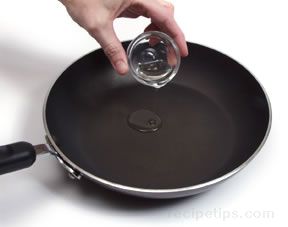
| Sautéing requires high heat, so it is best to use an oil that will not burn or smoke at high temperatures such as olive oil. The skillet must be preheated on the stove before adding the olive oil. Medium-high heat is sufficient to warm the pan to the proper temperature. If the heat is too high, the oil will begin to smoke shortly after it is poured into the pan. The food should be added to the pan just as the oil is on the verge of reaching the smoke point. |
 |
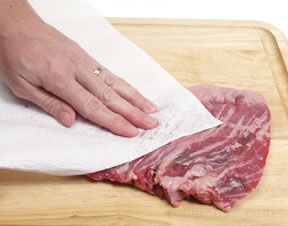
| The food should also be as dry as possible before it is placed in the pan. If the food is not dry, a layer of steam will develop between the food and the olive oil and the surface of the food will not sear as is should. |
 |
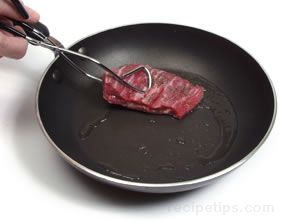
| The olive oil should sizzle when the food hits the pan. If the oil doesn't sizzle, the pan and oil are not hot enough. |
 |
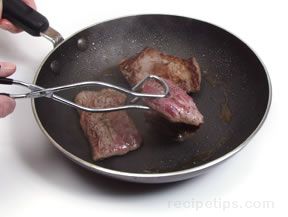
| When sautéing meat in olive oil, a tongs or spatula should be used to turn the meat once in the pan. Never use a fork because piercing the meat with a fork may allow juices to escape which will decrease the tenderness and flavor of the finished dish. A thin cut of meat should take no more than 2 to 3 minutes to cook per side. |
 |
Pan-Frying
Olive oil is ideal for pan-frying because it is the only cooking oil that preserves the actual taste of the food as it is fried. If not overheated, olive oil maintains is structural and nutritional components better than other oils.
Pan-frying is similar to sautéing except that a little more olive oil is used and since the process requires more time than sautéing, the food that is cooked does not have to be as thin. It is important that the olive oil is heated in the pan before food is placed in the pan to be fried. Food that is placed in a pan containing unheated olive oil, will soak up some of the oil. It is also important not to allow the oil to heat so long that it begins to smoke and burn, which will cause food to burn quickly on the outside before it has reached the proper doneness on the inside. The overheated oil will also ruin the flavor and aroma of the food.
When meat is pan-fried, it is patted with paper towels to remove excess moisture, seasoning is added, and then it is placed into a hot skillet containing heated olive oil. The oil should sizzle when the meat hits the pan. If it doesn't sizzle, the pan and oil are not hot enough.
The skillet should have a heavy bottom so that heat will be conducted more easily. A large, well-seasoned, cast-iron skillet works well or a heavy nonstick pan may be used. Make sure the pan is of adequate size so that there is plenty of room for the food to brown properly. If the pan is crowded, the food will steam more than it will brown. When pan-frying meat, do not use a fork to turn the meat in the pan because piercing the meat will allow juices to escape. A tongs or spatula are the best instruments to use.
Deep-Frying
Deep-frying, also known as deep-fat frying, is a process of immersing food in a pan or deep pot containing heated oil, which cooks the food quickly, producing a crispy surface over a tender and moist interior. It is best to use smaller pieces of food, such as strips or cubes of pork, beef, or poultry. Large pieces are difficult to handle, which increases safety concerns when cooking with hot oil.
The olive oil grade "olive oil," is excellent for deep-frying because it has a higher smoke point (410ºF) than virgin or extra virgin oils. Olive oil does not penetrate food during the cooking process as readily as some other types of oils, which results in a lower fat content in the finished dish.
There should be enough olive oil in the pan so that the food will be completely immersed when it is placed in the hot oil. The olive oil should be at a minimum depth of 2½ inches in the pan to properly cook smaller pieces of food. More oil may be required when cooking larger pieces.
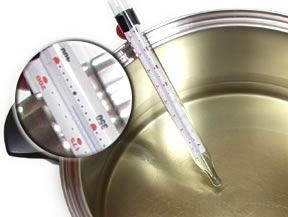
| A temperature between 350°F and 375°F is an ideal range for deep-frying. The olive oil grade "olive oil" has a smoke point of 410ºF, so it is an excellent choice for deep-frying (extra virgin and virgin olive oils have a lower smoke point than olive oil because they are unrefined). The correct temperature of the oil can be determined with the use of a candy thermometer. |
 |
To help prevent splattering, food should be as dry as possible before it enters the hot olive oil. The temperature of the oil may drop slightly when food is placed into it, so it may be necessary to increase the heat for a short time to return the oil to the proper cooking temperature.
Deep-frying is a safe process for cooking food if the proper equipment is used and common safety rules are followed:
- A wire basket may be used to hold the food so that it can be safely lowered and raised in the hot oil.
- Any utensils and equipment that come into contact with the hot oil must be thoroughly dried first. Moisture on the utensils will cause splattering, which can be dangerous.
- The hot oil should not be left unattended and children and pets should NEVER be allowed near the cooking area.
- A fire extinguisher and heavy potholders should always be within reach.
- After the cooking is completed, the oil should not be transferred to another container or disposed of until it has completely cooled. It is extremely dangerous to pour the hot oil from the cooking vessel.
Stir-Frying
|
The stir-frying process requires high heat and the tossing and stirring of ingredients in a large pan to ensure quick and even cooking. A cooking oil with a high smoke point should be used so that it will not burn at high temperatures. The olive oil grade "olive oil" is a good choice for stir-frying because it has a high smoke point (410ºF, due to refining) and can withstand the high temperatures necessary for stir-frying food. It is also one of the best choices because it contains no cholesterol and is very low in saturated fat. |
 |
|
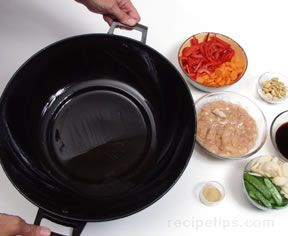
A wok is the traditional type of pan to use for stir-frying because it has deep tapered sides which allows food to be stirred and tossed easily. If a wok is not available, a deep heavy skillet works very well for stir-frying and nonstick pans are also easy to use. Wood or metal utensils should be used to stir the food. Plastic utensils should be avoided because they can melt.
All of the ingredients must be prepared and within reach before the stir-fry process can begin. All vegetables should be chopped and ready to go. Precut vegetables can be purchased in most food stores, but they are more expensive. Herbs and spices and any liquid ingredients should be measured before beginning. It is helpful to place the ingredients in small bowls so that everything is organized.
It is important to add the proper quantity of olive oil to the pan. Only 1 or 2 tablespoons of oil is required per pound of ingredients.
Different ingredients must be added to the pan at the appropriate times to ensure that all the ingredients are cooked properly. Some of the vegetables may require a longer cooking time than others so they should be added to the pan first. If everything is placed in the pan at the same time, the results will be unsatisfactory. The ingredients should be cooked until tender, but they should never be overcooked. |
| Note: Olive oil that has been used for sautéing, pan-frying, deep-frying, or stir-frying may be used again. The oil can be filtered after it is used to remove any impurities. If a strongly flavored food was fried in the olive oil, the oil can be freshened by frying a piece of citrus fruit, such as lemon or lime, or pieces of potato before the oil is filtered for reuse. Olive oil may be used 3 or 4 times when cleansed and filtered between uses. |
Grilling and Broiling
Grilling and broiling are essentially the same cooking technique: the application of intense, direct heat to the food, one side at a time. In grilling, the heat source is below the food; in broiling the heat source is above the food. The high heat necessary for grilling and broiling sears the surface of food, creating a flavorful browned crust.
In grilling, the temperature can be controlled by one of three methods:
- Raising or lowering the grilling rack, if it's adjustable, in relation to the heat source.
- By controlling the quantity and placement of the coals (charcoal grill).
- By having one or more burners turned off (gas grill).
In broiling, the temperature is adjusted by changing the distance between the food and the heat source. This is accomplished by changing the position of the oven racks in relation to the heat source.
When food is grilled, it is generally placed directly on the grilling rack, but when food is broiled, it is placed on a broiling pan. The broiling pan catches melting fat and juices that may drip from the food as it cooks. The broiling pan keeps the oven clean and it helps to prevent the fat from starting an oven fire.
Thinner pieces of food can be closer to the heat source than thicker pieces, since the thicker item will require more time to cook. If the thicker food item is too close to the heat source, the surface will char before the interior is cooked to the proper degree of doneness. Food should be watched carefully throughout the broiling process to make sure that it does not burn.
Many food items benefit from a coating of olive oil brushed onto the surface before they are grilled or broiled in order to enhance the flavor and provide a more crispy surface. To help prevent food from sticking while grilling, the cooking grate can be brushed with olive oil and then preheated on the grill before the food is placed on the grate.
Baking
Many people do not associate olive oil with baking, but it is one of the best oils that can be used for this purpose. Olive oil has been a favorite of bread bakers for centuries, because it results in bread with excellent flavor and texture. In Mediterranean countries, olive oil is used not only in bread making, but in other types of baked goods as well, including sweet items. In the United States, olive oil is used less often for baking, except in bread making. Many consumers in the U.S. are worried about baked items having a strong olive taste, however when light olive oil is used, it is difficult to detect an olive flavor in baked goods. Light olive oil is perfect for baking cakes, sweetly flavored breads, or rolls.
Using olive oil instead of butter in baking allows some of the fat required for a recipe to be eliminated. About 25% less olive oil is required for most baked items. The use of olive oil instead of butter also eliminates much of the saturated fat and cholesterol contained in many dessert cakes and rolls, making them healthier and more nutritious. The natural antioxidants (such as vitamin E) in olive oil help to keep baked items fresher for a longer period compared to items baked with butter.
|
Use the chart below to convert the quantity of butter
called for in a recipe to the required quantity of olive oil. |
| Butter |
Olive Oil |
| 1 teaspoon |
3/4 teaspoon |
| 2 teaspoons |
1-1/2 teaspoons |
| 1 tablespoon |
2-1/4 teaspoons |
| 2 tablespoons |
1-1/2 tablespoons |
| 1/4 cup |
3 tablespoons |
| 1/3 cup |
1/4 cup |
| 1/2 cup |
1/4 cup and 2 tablespoons |
| 2/3 cup |
1/2 cup |
| 3/4 cup |
1/2 cup and 1 tablespoon |
| 1 cup |
3/4 cup |
Cooking Tips
- Use olive oil in marinades for meat, fish, or poultry.
- Instead of serving butter with bread, pour some olive oil into a saucer or onto a small plate for dipping.
- If you plan on frying using butter, add a bit of olive oil to help prevent the butter from burning.
- Brush olive oil onto meats while broiling, grilling, or roasting to help brown the meat and seal in the juices.
- Use olive oil instead of butter on cooked vegetables.
- Substituting olive oil for butter in baked goods allows a smaller quantity to be used; in most cases up to 25% less fat is used when baking with olive oil. Light olive oil is ideal for baked goods because of its subtle flavor.
- The olive oil grade "olive oil," is excellent for deep-frying because it has a higher smoke point (410ºF) than virgin or extra virgin oils.
- When using olive oil for deep-frying, food should be as dry as possible before it enters the hot oil to prevent splattering.
|


