|
Sweet Peppers | Chile Peppers |Pepper Preparation | Pepper Cooking | Tips
| Sweet Peppers |
|
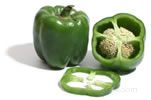
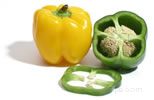
A sweet pepper is a mild to sweet flavored pepper that can be eaten raw or cooked. Some varieties have a sweet but bitter taste. There are many varieties of sweet peppers, such as bell, bull horns, cachucha, cubanelle, European sweet, pimento and sweet banana. The different varieties vary in size, shape, thickness and color. The most common color is green at maturity and red when allowed to fully ripen. Some other common maturity colors are ivory, yellow, orange, purple and brown but the majority turn red when allowed to ripen. |
|
Uses:
Sweet peppers are eaten raw or cooked and are good in salads, savory dishes, stuffed or eaten on their own. |
| At Their Best:
A pepper has the strongest taste when considered mature, but not fully ripe. If the peppers are not harvested when mature but are allowed to ripen on the vine, their taste will become progressively mild and sweet until they are fully ripened. Sweet peppers are available throughout the year but more varieties are available in July, August and September. |
|
How to Buy: When selecting, choose those with shiny, even colored skins that are not blemished or bruised. Avoid peppers with shriveled skins. |
|
Storage:
They can be stored for at least a week if placed in a plastic bag and kept in the refrigerator. The riper the pepper is when harvested, the less time it will maintain its freshness. |
| Varieties: |
|
Bell Peppers
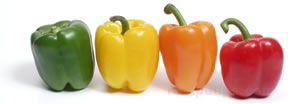 |
A mild, sweet flavored, bell shaped pepper, which is one of the most common varieties of sweet peppers. Most bell peppers are green at maturity but turn red if not harvested until fully ripe. There are some varieties that have a maturity color other than green, such as yellow, orange, purple and brown. Most (but not all) varieties are red when fully ripened. A pepper has the strongest taste when considered mature, but not fully ripe. If the peppers are not harvested when mature but are allowed to ripen on the vine, their taste will become progressively more mild and sweet until they are fully ripened. Bell peppers are eaten raw or cooked and are good in relishes, salads, savory dishes or stir-fries, and can be stuffed or eaten on their own. |
Sweet Banana Pepper
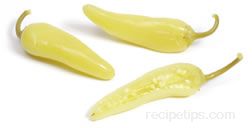 |
A variety of pepper that has a banana shape and is less than half a foot in length. It has a waxy yellow skin that turns red when fully ripe. The flavor is sweet and mild and it is also known as the banana pepper. |
| Chile Peppers |
|
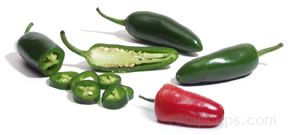
A generic name, also spelled "chili," given to a broad range of over 200 varieties of hot peppers. Chile peppers are grown in different shapes, sizes, and flavors. From round to long and narrow, the pepper can range in size from less than an inch to over 12 inches in length. They can be round and globe-shaped or long and narrow with a pointed end. The intensity of their flavor ranges from mild to extremely hot. When preparing hot peppers, use caution not to touch the eyes or similar areas that can be painfully affected by the capsaicin that rubs off on hands. Some of the most common chile peppers are: Anaheim, Ancho, Cascabel, Cayenne, Charleston hot, Cherry pepper, Chilaca, Chilhuacle, Chipolte, Fresno, Guajillo, Guero, Habanero, Jalapeno, Jamaican hot, Italian frying, Japanese Sweet, Mulato, Pasilla, Pepperoncini, Pequin, Pimiento, Poblano, Red Pepper, Ristra, Santa Fe Grande, Scotch Bonnet, Serrano, Sweet Peppers, Thai Chile, Togarashi, and Viejo Arruga Dulce. Some of the smallest varieties of peppers are round peppers that are often referred to as "ornamental" or "wild" peppers. There are a variety of colors such as red, green, black, and purple readily available and can be used to add color or flavor to various dishes. |
|
Uses:
Chile peppers are eaten raw or cooked and are a perfect addition to salads, savory dishes, and can be stuffed or eaten on their own. |
| At Their Best:
Generally, intensity of the heat in the taste of the pepper decreases as the size of the pepper increases. Thus, the larger peppers are most often mild, while the smaller peppers are spicy and hot. The fiery burning sensation present in some peppers is due to the natural substance called capsaicin that produces the hot taste in our mouth. Capsaicin is present in the inner white ribs running down the middle and sides of the pepper. Removal of the ribs and seeds that rub against the ribs will reduce the hot intensity of the pepper. |
|
How to Buy: Peppers are available in various colors such as red, green, orange, yellow, white, and black. When selecting peppers, choose any that do not have a wrinkled or dull colored outer flesh. |
|
Storage:
Fresh peppers are best stored in a refrigerator while dried peppers are best kept in dry, dark cool storage areas. When preparing hot peppers, use caution not to touch the eyes or similar areas that can be painfully affected by the capsaicin that rubs off on hands. |
| Varieties: |
|
Anaheim Chile
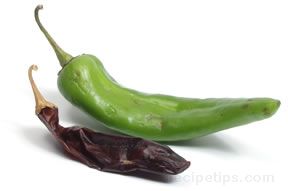 |
A type of chile pepper that is about a half-foot in length, is green in color, and has a mild to medium-hot flavor. It is sold fresh and is also available roasted, dried, or canned. When the chile is dried, it turns a dark burgundy color. It is sometimes referred to as the New Mexico chile, but New Mexico chiles are a bit hotter. Anaheim chiles are a good complement to egg dishes, stews, and vegetable dishes. |
Ancho Chile
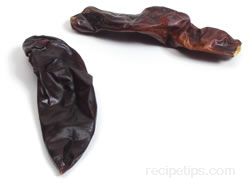 |
A dried red chile that is under a foot in length with a mild, full flavor. When it is fresh it is green colored and is known as a poblano chile. |
Habanero Chile
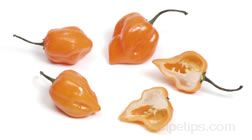 |
A small chile that is no more than 2 inches in length and has a color that ranges from light green when fresh to bright orange when dried. It is native to Caribbean regions, the Yucatan area of Mexico, and northern coastal areas of South America. The habanero has subtle fruit flavors and is many times hotter than the jalapeno. |
Jalapeno Chile
|
One of the most popular chiles because of its hot and spicy flavor and because of the ease in which the seeds are removed. Jalapenos are green when harvested and will turn red if left for a longer period to ripen. They can be purchased fresh or canned and are also popular when pickled. Jalapeno chile peppers that are smoked and dried are known as chipotle chiles. |
New Mexico Chile
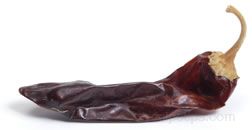 |
A type of chile pepper that is about a half-foot in length, is green in color, and has a mild to medium-hot flavor. It is similar to an Anaheim chile, but it is a bit hotter. It is sold fresh and is also available roasted, dried, or canned. When the chile is dried, it turns a dark burgundy color. It is sometimes referred to as a dried Anaheim Chile. New Mexico chiles are a good complement to egg dishes, stews, and vegetable dishes. |
Poblano Chile
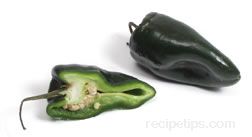 |
A dark blackish green, triangle shaped pepper, which is an average of 4 inches long and wide at the top, tapering to a blunt end. When fully mature it turns a reddish brown. It is mild to medium hot and has a rich bell pepper flavor. The Poblano is used as a stuffing pepper, and is added to soups and sauces. The wrinkled and flattened Ancho and Mulato are dried forms of the Poblano. The Ancho and Mulato have a mild sweet flavor. |
Fresno Chile
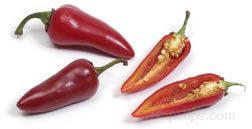 |
A variety of pepper grown commonly in the U.S. that is picked when green or red. The immature green colored pepper is mild to medium hot in flavor, unlike the red, which has a deeper fiery flavor that exceeds the Jalapeno in intensity. When harvested, this waxy-skinned pepper has a thick flesh and is typically 2 to 3 inches in length with a pod width of an inch or less. The Fresno pepper is very similar in appearance and taste to a Jalapeno or Serrano. The green variety is often added to main dishes, side dishes, salads, and salsas, while the red variety may be too hot for some dishes, but is often used with rice, in dips or chopped into fine bits and added to salsas. |
Serrano Chile
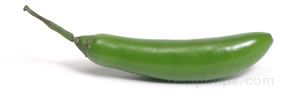 |
Serrano is a Spanish word meaning "mountain" which may signify the origin and growing area of these chiles. The chile is green in color, long and narrow in shape, and grows into a medium thick wall. This chile is often used in salsas and as a flavoring for stews, casseroles and egg dishes. |
|
Chili Piquin
|
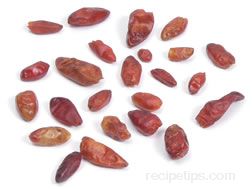
One of the smallest chili peppers but also one of the hottest. The chili is very small and has an elongated shape. It is very similar in taste and hotness to the Chiltepin. The Chiltepin is just a little smaller than the Chili Piquin and has a more rounded shape. They are often mistaken for each other. They are both very popular and eaten fresh or dried. Their heat is slow to take affect but stays with you for a long time. Younger chilies are green in color and as the mature they turn red. When dried they turn a brownish-red. The hottest parts of the chili are the ribs and seeds. Removing some or all of these parts will reduce the degree of hotness. Chili Piquin and Chiltepin chilies are used in chili, stews, and sauces. They are available fresh, dried, and in powder form. They can be stored in the refrigerator, unwrapped, for up to a week. Do not store in plastic because this will allow them to retain moisture and cause them to rot. |
Pepper Preparation
|
Coring a Bell Pepper
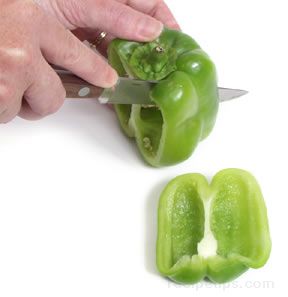
Cut pepper lengthwise on all four sides, cutting around the stem, seeds, and ribs. |
 |
|
Prepare Cored Pepper for Slicing
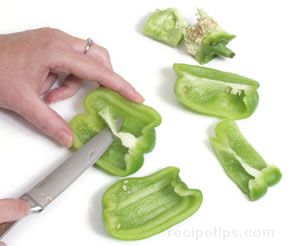
With the utility knife, remove any remaining rib. |
 |
|
Squares
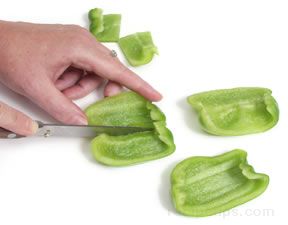
To create squares, slice each of the four sections in half. |
 |
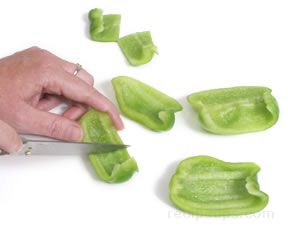
| Slice across each section to create desired size. |
 |
|
Julienne Strips
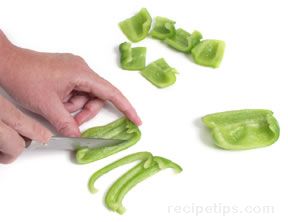
Create Julienne strips by slicing quartered piece into thin strips. |
 |
|
Minced/Chopped Peppers
To create minced or chopped peppers, chop Julienne stips to desired size. |
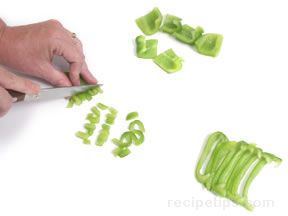 |
|
Prepare Pepper to Stuff (Hollow Pepper)
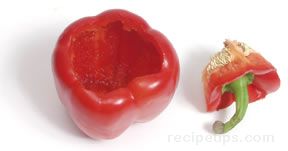
Begin by cutting a circle around the stem of the pepper.
|
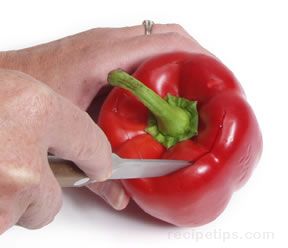 |
| Carefully pull out the stem and ribs. |
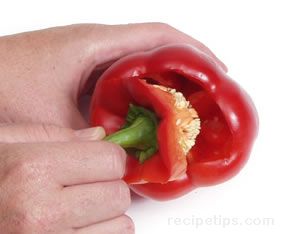 |
|
Remove the remaining ribs by scraping with a spoon. |
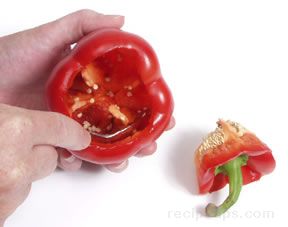 |
|
Wash the pepper in cold running water to remove any remaining seeds.
Stuff the cavity of the pepper with stuffing mixture or dip. |
 |
|
Prepare Pepper Rings
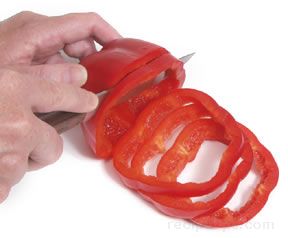
To prepare pepper rings, first follow the directions for hollowing out a pepper. Slice the bottom of the ring off. The bottom is edible and should be chopped and saved for later use. Simply slice the pepper in quarter inch slices. The pepper rings also make a decorative garnish.
|
 |
|
Preparing a Chile Pepper
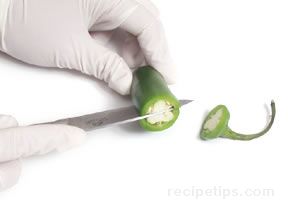
When preparing hot peppers, use caution not to touch the eyes or similar areas that can be painfully affected by the capsaicin that rubs off on hands. Wearing rubber gloves is recommended as well as washing hands immediately after removing the gloves.
If you do handle chile peppers without using rubber gloves and your hands begin to burn, rub them with vinegar or alcohol to help stop the burning. |
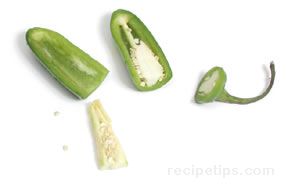
| Begin by removing the stem and slicing the chile pepper in half. |
 |
|
With a teaspoon, carefully remove the ribs and seeds. |
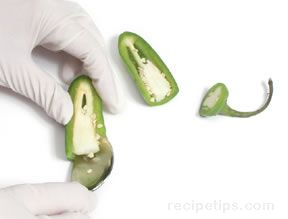 |
| After the ribs and seeds have been removed, the sections should be left whole if the peppers are going to be stuffed. |
 |
|
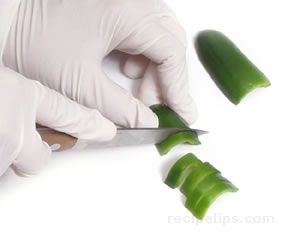
To cut the section into smaller pieces, slice across the section to create the desired size.
The cleaned pepper can also be cooked if required. |
 |
Pepper Cooking
Grilling/Broiling Peppers
Grilling:
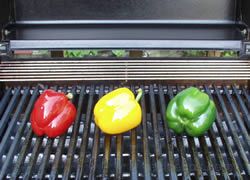
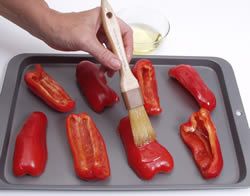
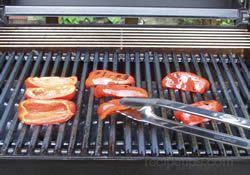
| Preheat the grill on high. While grill is preheating cut peppers in half or quarters. Remove stems, ribs and seeds. Brush peppers with oil. |
 |
|
|
 |
|
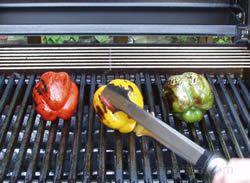
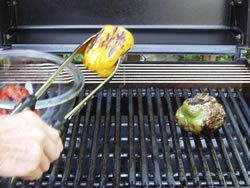
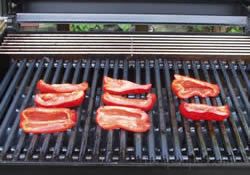
Place the peppers on the grill directly over medium heat. Cook for 6 to 10 minutes, turning once throughout cooking time.
Remove peppers from the grill when they are tender-crisp and nicely browned. Eat as desired. |
Roasting on the Grill:
Broil:
- Preheat broiler. Prepare each pepper by removing the stem and cutting them lengthwise in halves or quarters
- Flatten each pepper section and place skin side up on a foil lined baking sheet.
- Brush skins lightly with olive oil and broil for 8-10 minutes, or until tender with charred skins. Peppers can be eaten with the skin on or off.
Tips
- Brown, black, and purple bell/sweet peppers turn green when cooked.
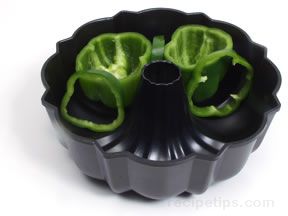
- A bundt pan is not only a great way to present stuffed peppers, it is also a convenient way of transporting them.
- Counteract the hot taste of a chile pepper by consuming milk, bread, or rice to absorb the intensity of the capsaicin.
|