Composition of an Egg | Types of Chicken Eggs | Other Types of Eggs
Composition of an Egg
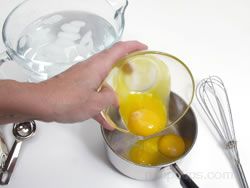
 An egg is composed of several structures that all serve an important function in its construction. Besides the shell, yolk, and white, the egg contains an air cell, a chalaza, a vitelline membrane, and shell membranes. It is helpful to understand the function and importance of each structure to obtain knowledge that can be useful when preparing eggs. An egg is composed of several structures that all serve an important function in its construction. Besides the shell, yolk, and white, the egg contains an air cell, a chalaza, a vitelline membrane, and shell membranes. It is helpful to understand the function and importance of each structure to obtain knowledge that can be useful when preparing eggs. |
| Note: Since chicken eggs are the predominate variety used in cooking, all of the information presented in these pages concerning preparation, cooking, nutrition, safety, handling, and egg products, refers to eggs from chickens, except where noted. |
Eggshell
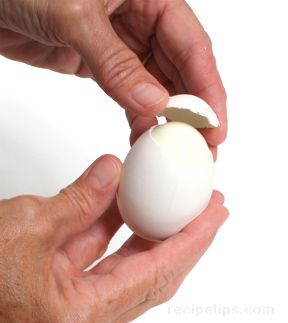 The shell is the outer covering of the egg, which protects the contents from damage and contamination. The shell is composed mainly of calcium carbonate and may contain as much as 12% of the total weight of the egg. The shell is the outer covering of the egg, which protects the contents from damage and contamination. The shell is composed mainly of calcium carbonate and may contain as much as 12% of the total weight of the egg.
The surface of the shell is covered with thousands of microscopic holes which makes it quite porous. A natural coating referred to as the "bloom," helps to seal the holes, preventing bacteria from entering. As the egg ages, the bloom is worn away, which allows moisture to slowly escape and air to enter, thus increasing the size of the air cell already present in the egg. Bacteria may also enter the egg, which may result in contamination.
When eggs are packaged for sale to consumers, they are carefully washed to remove germs that may be on the surface. This procedure removes the natural bloom, so a thin coating of mineral oil is applied to take the place of the bloom. This oil coating acts in the same manner as the natural bloom, keeping the contents fresh for longer periods.
The thickness and strength of the shell are determined mainly by the age of the hen and by the diet of the hen. Calcium, Vitamin D, and phosphorous are important nutrients that the hen must have in its diet in order to promote proper shell formation.
Hens produce larger eggs as they age, but the thickness of the shell decreases. This is because the same quantity of shell material is produced, but it must cover a larger volume of contents.
|
Air Cell
After the hen lays the egg, the contents of the egg begins to cool and contract. This allows air to be trapped between the two membranes beneath the shell. The trapped air produces an air cell, which forms at the large, rounded end of the egg. The size of the air cell is one of the criteria used when grading eggs. The air cell is visible as the egg passes in front of a bright light (the candling process).The smaller the air cell, the higher the grade of the egg. The size of the air cell increases as the egg ages. An egg may actually float in water if it is very old, which indicates that the contents have lost moisture and the air cell has become very large.
|
Egg White
 The egg white, also known as the albumen, surrounds the yolk with four different layers. The layers alternate from thin nearest the shell, to thick, to thin again, and finally, to thick again nearest the yolk. The individual layers are referred to as follows: The egg white, also known as the albumen, surrounds the yolk with four different layers. The layers alternate from thin nearest the shell, to thick, to thin again, and finally, to thick again nearest the yolk. The individual layers are referred to as follows:
- Thin Outer White: the layer nearest the shell.
- Thick Outer White: moving toward the inside, the layer after the thin outer layer.
- Thin Inner White: the layer after the thick outer layer, once again,moving toward the inside.
- Thick Inner White: the layer next to the yolk membrane.
The egg white accounts for about two-thirds of the liquid mass of the egg and contains over half of the protein content. It has none of the egg's cholesterol, which averages 213 milligrams and is all contained within the yolk. The egg white is not actually white in color, but opalescent. It is not until the egg is beaten or cooked that the albumen turns an opaque white.
|
Chalaza
The chalaza is a thick strand of the egg white that serves as an anchor. It helps to secure the yolk in the center of the thick inner white layer. The chalaza does not have to be removed before preparing the egg and it can be beaten or cooked with the rest of the egg without creating any problems. There may be some finely textured dessert recipes that may benefit from its removal, such as custards, but it isn't a necessity.
|
Yolk
The yellow center portion of the egg is known as the yolk. The liquid content of the yolk is enclosed by the vitelline membrane, which protects the yolk from breakage. As the egg ages, the vitelline membrane loses some of its strength, so the yolk is more likely to break.
Compared with the egg white, the yolk has a greater proportion of the egg's nutritional value. Some of the egg's nutrients, such as zinc, vitamin A, vitamin D, and vitamin E, are fully contained within the yolk. About one-third of the liquid mass of the egg is contained within the yolk, but it contains 100% of the egg's fat content and cholesterol and nearly half of the protein. |
Types of Chicken Eggs
Standard Chicken Eggs
|
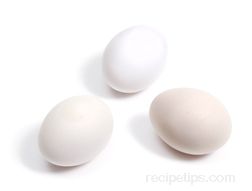
White Eggshells
Chicken Breed:
Leghorn, Ancona, and others |
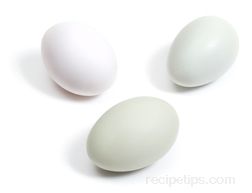
Commercially produced chicken eggs are used more often than any other type of chicken egg and are the eggs most commonly found in food stores. Chicken eggs with white shells make up the bulk of the eggs sold in food stores. Occasionally, nonwhite eggshell colors are available, especially from local producers and in farmers markets. The color of the shell is determined by the breed of the hen and has nothing to do with the flavor, texture, or nutritional value of the egg. The only factors that may have an affect on any of these characteristics are the age of the egg and the diet of the hen. Brown eggshells are the most common color available, but green, blue, pink, and light red colors are sometimes seen. |
|
Other Chicken Eggshell Colors
|
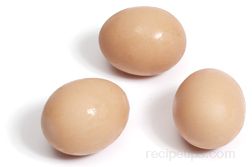
Brown Eggshells
Chicken Breed:
Rhode Island Red and others
|
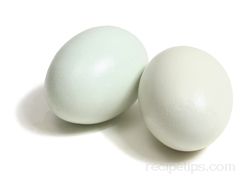
Light Blue Eggshells
Chicken Breed:
Americana
|
|
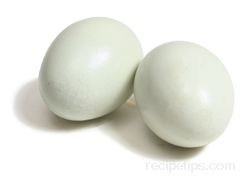
Light Green Eggshells
Chicken Breed:
Americana
|
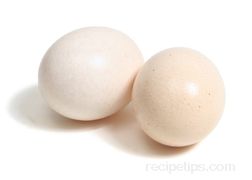
Light Pink Eggshells
Chicken Breed:
Americana
|
|
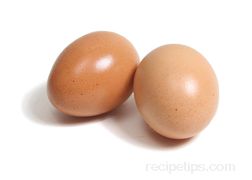
Dark Brown, Rust, or Red Eggshells
Chicken Breed:
Sexlink, Maran, Wesummer, and others
|
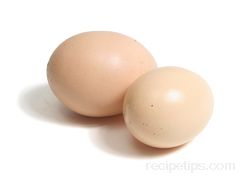
Light Rust or Light Red Eggshells
Chicken Breed:
Wyandotte and others
| |
Fertile Eggs
The term fertile egg refers simply to an egg that can be incubated and developed into a chick. Many people mistakenly believe that fertile eggs are more nutritious than non-fertile eggs, but there is no difference in the nutrient value between the two. Fertile eggs have higher production costs; therefore, they are more expensive for the consumer. Fertile eggs also spoil faster than non-fertile eggs.
|
Organic Eggs
Organic eggs are produced from hens that have been given feed in which all of the ingredients were grown without the aid of commercial fertilizers, pesticides, or herbicides. This results in higher production costs, which in turn, makes organic eggs more expensive for the consumer than non-organic. In terms of nutritional value, organic eggs are no different than non-organic eggs.
|
Free-range Eggs
Free-range is the name given to eggs produced by hens that have been raised outdoors (rather than inside large buildings with a controlled environment); however, because of climate considerations in many locales, most hens are not raised entirely in the open. Eggs may be called free-range if the hens have daily access to the outdoors but may not actually spend that much time outdoors. The cost of a free-range egg is higher because of additional costs encountered by free-range egg producers, but there is essentially no difference between a free-range egg and an egg produced from a confined hen. There is no difference in the flavor or texture, and the nutritional value is also the same. |
Other Types of Eggs
There are other types of eggs used in cooking, such as quail, duck, goose, turkey, and ostrich, but they are not used nearly as often as chicken eggs. An important point to remember is that these egg varieties are more likely to contain harmful bacteria than chicken eggs, so they should always be well cooked.
|
Quail Eggs
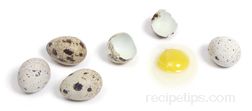
Quail Eggs are much smaller than chicken eggs, but the flavor is similar. Five quail eggs are equal to one chicken egg. The shells are speckled and range in color from dark brown to blue or white. Quail eggs are often hard-boiled and served as a food garnish, appetizer or hors d'oeuvre, or as an accompaniment for salads.
|
Duck Eggs
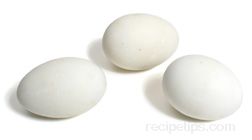
Duck Eggs are slightly larger than chicken eggs. The chalaza of a duck egg is not as noticeable as it is in a chicken egg, and the egg white is more transparent with less yellow coloring. Duck eggs have more flavor than chicken eggs, but they also have a higher fat content and more cholesterol. The egg white has a greater level of albumen (the protein of the egg white) than a chicken egg. Because of their richness and gelatinous properties, duck eggs are well suited for dessert recipes. The duck eggs that are usually available to consumers are quite large, but producers sell duck eggs in sizes ranging from very small to jumbo.
|
Goose Eggs
Goose Eggs are much larger than either chicken or duck eggs. They have more flavor than chicken eggs, are very rich, and like duck eggs, are best suited for use in dessert dishes. Goose eggs are extremely high in fat and cholesterol (over 1200 mg. per egg), so they should be used sparingly.
|
Turkey Eggs
Turkey Eggs are similar to chicken eggs, but are larger and have shell colors ranging from white to cream with brown speckles. They are approximately 1½ times larger than a jumbo chicken egg and are very high in cholesterol and fat, but the flavor is similar. Turkey eggs are rarely available to the consumer because most of the eggs are used for hatching more turkeys, but they are sometimes found in specialty markets.
|
Ostrich Eggs
Ostrich Eggs are hard to find, but one egg goes a long way. One ostrich egg is equal to 20 to 24 large chicken eggs. They are mainly sold for novelty value and one egg can be made into several large omelets or it can be scrambled. | |