RecipeTips.Com Home cooking tips & advice | Knowledge | Egg Shopping Guide
Join Now | Sign In | RSS Feeds RSS Feeds
Egg Shopping Guide: Easy How-To Cooking Tips & Advice: RecipeTips.com
Recipes Cooking Tips & Advice Glossary Community Videos
hints
e-Newsletter
RecipeTips.com Newsletter Sign Up

Egg Shopping Guide

print Print Egg Shopping Guide article  |  email Email Egg Shopping Guide article  |  rate this article Rate this article  | Bookmarks
Eggs > Egg Shopping Guide
Composition | Color | Size | Grades | Freshness

Composition

An egg is composed of several structures that all serve an important function its construction. Besides the shell, yolk, and white, there is the air cell, chalaza, vitelline membrane, and shell membranes. It is helpful to understand the function and importance of each structure to obtain knowledge that can be useful when shopping for eggs as well as preparing them.

Shell

The shell is the outer covering of the egg which protects the contents from damage and contamination. The shell is composed mainly of calcium carbonate and may contain as much as 12% of the total weight of the egg.

The surface of the shell is covered with thousands of microscopic holes which makes it quite porous. A natural coating referred to as the the "bloom" helps seal the holes, preventing bacteria from entering. As the egg ages, the bloom is worn away, which allows moisture to slowly escape and air to enter, forming the "air cell". Bacteria may also enter, and contamination may result. When eggs are packaged for sale to consumers, they are carefully washed to remove germs that may be on the surface. This removes the bloom, so a thin coating of oil is applied to take the place of the bloom. This works in the same way as the bloom, keeping the contents fresh for longer periods.

The thickness and strength of the shell are determined mainly by the age of the hen and the hen's diet. Calcium, Vitamin D, and phosphorous are important nutrients in the hen's diet in order to promote proper shell formation. Hens produce larger eggs as they age, but the thickness of the shell decreases because the same quantity of shell material is produced which must cover a larger volume of contents.

Air Cell

After the egg is laid and then cools, the contents contract allowing air to be trapped between the two membranes beneath the shell. The trapped air produces an"air cell" which forms at the large, rounded end of the egg. The size of the air cell is one of the criteria used when grading eggs. The air cell is visible as the egg passes in front of a bright light (candling).The smaller the air cell, the higher the grade of the egg. The size of the air cell increases as the egg ages. An egg may actually float in water if it is very old, indicating that the contents has lost moisture and the air cell is very large.

White

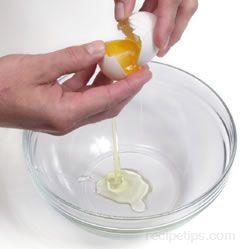
The egg white, also known as the albumen, surrounds the yolk with four different layers. The layers alternate from thin nearest the shell, to thick, to thin again, and finally to thick again nearest the yolk. The individual layers are referred to as:

  1. Thin outer white: the layer nearest the shell.
  2. Thick outer white: the layer after the thin outer layer, moving toward the inside.
  3. Thin inner white: the layer after the thick outer layer, moving toward the inside.
  4. Thick inner white: the layer next to the yolk membrane.

The egg white accounts for about two-thirds of the liquid mass of the egg and contains over half of the protein content. It has none of the egg's cholesterol, which averages 213 milligrams and is all contained within the yolk. The egg white is not actually white in color, but is opalescent. It is not until the egg is beaten or cooked that the albumen turns an opaque white.

Chalaza

The chalaza is a thick strand of the egg white that serves as an anchor. It helps to hold the yolk in the center of the thick, inner white layer. The chalaza does not have to be removed before preparing the egg and it can be beaten or cooked with the rest of the egg without creating any problems. There may be some finely textured dessert recipes, such as custards, that may benefit from its removal, but it isn't a necessity.

Yolk

The yellow center portion of the egg is known as the yolk. The liquid content of the yolk is enclosed by the vitelline membrane which protects the yolk from breakage. As the egg ages, the vitelline membrane loses some of its strength, so the yolk is more apt to break.

Compared with the egg white, the yolk has a greater proportion of the egg's nutrients. Some of the egg's nutrients, such as zinc, vitamin A, vitamin D, and vitamin E, are fully contained within the yolk. About 1/3 of the liquid mass of the egg is contained within the yolk, but it contains 100% of the egg's fat content and cholesterol and nearly half of the protein.

Color

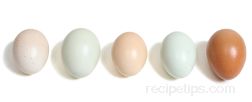
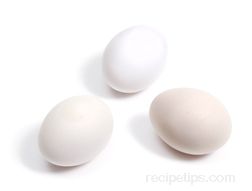
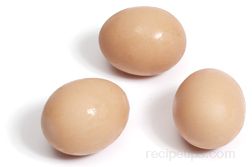
The egg shell and/or the yolk may differ in color from one egg to the next. An egg shell color other than the usual white and a yolk that is not a perfect golden yellow do not indicate that there is a problem with the egg or that there will be any difference in the flavor, nutrition, or other characteristics.

The shell color of a chicken egg is determined by the breed of the chicken. Even though there is no difference between white and brown eggs other than the shell color, brown eggs are slightly more expensive because the breeds that lay them are larger and require additional food. The extra cost of the additional feed results in extra cost for the consumer.

The color of the egg yolk is usually determined by the hen's diet. Feed produced with yellow or orange ingredients results in the usual golden color of the yolk. Lighter colored ingredients result in paler, lighter yolks. Natural ingredients with yellow or orange pigments may be mixed with feed to brighten the yolk color, but the addition of artificial pigments is not allowed.

A blood spot may be found on the egg yolk, but this is a rare occurrence. Most eggs with blood spots are removed during the candling operation, but a few may slip through and reach the consumer. The blood spot does not affect the quality or flavor of the egg and it actually indicates that the egg is very fresh because the blood spot tends to get diluted as the egg ages.

Size

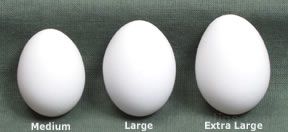
Eggs are available in several sizes and are referred to as peewee, small, medium, large, extra large, and jumbo. The most common sizes that are available to consumers are medium, large, and extra large.

The size of the egg is determined by several factors including:

  • The age of the hen
  • The breed of the hen
  • The weight of the hen
  • Nutrition
  • Environmental conditions

The net weight in ounces per dozen is the standard that is used to classify egg sizes.

  • 1 dozen medium eggs = 21 ounces
  • 1 dozen large eggs = 24 ounces
  • 1 dozen extra large eggs = 27 ounces

Many recipes requiring eggs specify the use of large eggs, so if the eggs you have available are smaller or larger, it is beneficial to know the size equivalents. Use the following guidelines to achieve a quantity that should work well for most recipes.

  • 5 medium eggs = 4 large eggs = 4 extra large eggs
  • 6 medium eggs = 5 large eggs = 4 extra large eggs
  • 7 medium eggs = 6 large eggs = 5 extra large eggs

For a more precise measure:

  • 1 medium egg = 3 tablespoons
  • 1 large egg = 3¼ tablespoons

    Therefore:

  • 13 medium eggs yields exactly the same quantity (39 tablespoons) as 12 large eggs.

Grades

The grade of an egg refers to the quality of the egg and has nothing to do with the size. The interior of the egg is inspected as well as the exterior. In order to inspect the contents of the egg, a process called "candling" is used. Candling is the process of passing eggs in front of bright lights to reveal the contents inside the shell. Before the development of electric lighting, eggs were passed in front of candle flames, which is how the name "candling" came about. Among the characteristics that determine the quality of eggs are:

  • Shell: Is the shell a good shape or is it abnormally formed? Are there cracks, stains, rough spots, or ridges?
  • Air cell: Is the air cell barely noticeable or is it quite large? Higher grade eggs have a small air cell, indicating that the egg is very fresh. The size of the air cell increases as the egg ages.
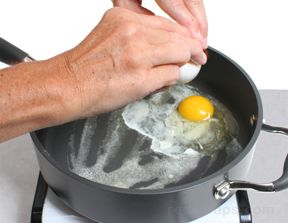
  • Appearance after breaking: Does the egg cover a small area when it is opened or does it spread out into a wider area? The contents of a higher quality egg will cover a smaller area.
  • Albumen: The proportion of thick white compared to the thin white should be greater in a high grade egg and the chalaza should be very noticeable.
  • Yolk: A high grade egg should have a yolk that is plump and round. The yolk in a lower grade egg is flattened and limp.
  • Blood spots: If egg yolks have blood spots, they are typically removed, although the blood spot does not affect the quality or flavor of the egg.

The USDA classifies eggs with the following grades:

Grade AA This is the highest quality possible. Because of their quality, grade AA eggs can be used for any purpose, but are especially useful for cooking methods in which the egg is cooked in the shell.
Grade A The quality is slightly less than that of a grade AA, but most consumers wouldn't notice the difference. The air cell is slightly larger, the proportion of thick to thin albumen is not as great, and the contents may spread out a bit more once the egg is cracked open. A and AA are the grades that consumers will find in food stores.
Grade B The decrease in quality is much more noticeable. The shell may be discolored, blemished, and oddly shaped. The air cell may be very large and the contents more runny, but the nutritional value is the same as higher grades and the flavor is similar. Most grade B eggs are used by commercial operations that produce egg products and some are used by commercial bakers.

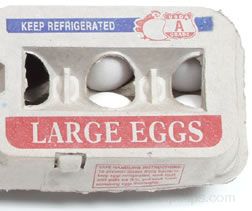
The picture below shows the USDA seal
for "Grade A" eggs in the upper right corner of the carton.
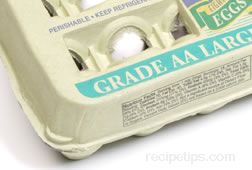
"Grade AA" eggs

Freshness

The freshness of an egg is not only determined by the date when the egg was laid, but also by the way the egg has been stored. Proper handling and storage is perhaps the most important factor in determining freshness. If a freshly laid egg is left at room temperature for a full day, it will not be as fresh as a week old egg that has been refrigerated between 33° and 40°F from the time it was laid.


USDA (United States Department of Agriculture) inspected eggs have a date stamped on the carton indicating the last day that the eggs can be legally sold. This "sell by date" is no more than 30 days beyond the date the eggs were packed. Eggs are usually packed within a week of being laid, but they may be packed as long as 30 days after being laid, which is within USDA regulations. The pack date is a 3 digit code that is stamped on the carton near the sell by date. Each day of the year is given a number from 1 to 365, with January 1st indicated by the number 1 and December 31st indicated by the number 365. The number 105 on the carton shown indicates that the eggs were packed on April 15, the 105th day of the year. (The number to the left of 105 is a code number used by the packing company). Eggs can be sold up to a month after the packing date and if they are properly refrigerated, they are generally safe to eat as much as a month after the sell by date. A general rule to follow is that any egg that looks or smells odd should not be used.

More Eggs >>

Egg Shopping Guide article - Related Content

Collections
Chicken Recipes

Chicken Recipes

View our collection of free chicken recipes including oven baked chicken and chicken breast recipes.
Cakes

Cakes

Browse our selection of cake recipes for birthdays or any occassion.
Pie Recipes

Pie Recipes

We have a huge selection of pie recipes to choose from including fruit pies, cream pies and custard
Cookie Recipes

Cookie Recipes

Browse our cookie recipes, we have a lot to choose from.
Bars

Bars

View our fabulous assortment of bar recipes.
Recipes view more
Egg Salad with Smoked Salmon and Dill

Egg Salad with Smoked Salmon and Dill

This is a great recipe that can be served as a sandwich or on baguettes as an appetizer.
Egg Foo Yung Sauce

Egg Foo Yung Sauce

A seasoned sauce that goes well with many egg dishes but especially with Egg Foo Yung to add a savory flavor to the eggs.
Egg Foo Yung

Egg Foo Yung

Topped with a savory sauce, this egg dish is great for morning meals or to serve guests for a brunch, lunch or dinner selection.
Egg Foo Yung with Sauce

Egg Foo Yung with Sauce

Made for breakfast, lunch or dinner, Egg Foo Yung provides an enjoyable way to add texture and healthy ingredients to an egg dish.
Egg Salad with Herb Croutons

Egg Salad with Herb Croutons

This tasty salad can be varied to use whatever fresh vegetables are available. Try julienned carrots, broccoli florets, halved cherry tomatoes, thinly sliced radishes, strips of sweet pepper, or whatever you prefer.
Cooking Tips & Advice
Fish Shopping Guide

Fish Shopping Guide

Fish Cuts When shopping for fish, it is beneficial to know what the different types of cuts of fish are so that you know exactly what you are purchasing. The basic cuts ...
Ham Shopping Guide

Ham Shopping Guide

Making a Selecting | Description of Cuts | Read the Label Look and Feel | Quantity to Buy When shopping for ham there ...
Lamb Shopping Guide

Lamb Shopping Guide

Selecting Cuts | Inspection and Grading | Look and Feel | Quantity to Buy Selecting Cuts A successful outcome in cooking lamb depends on matching the recipe or cooking ...
Pork Shopping Guide

Pork Shopping Guide

Tips on Selecting Cuts | Terms | Description of Cuts | Inspection and GradingRead the Label | Look and Feel | Quantity to Buy | Purchasing in Quantity When shopping for ...
Oils and Fats Shopping Guide - Olive Oil

Oils and Fats Shopping Guide - Olive Oil

Marketing Methods | Quality Factors | Purchasing Tips | Read the Label Olive oil has been a staple in the Mediterranean diet for centuries and has also become very ...
Glossary Terms
Egg Ring

Egg Ring

Approximately 3 inches in diameter, an Egg Ring is made to hold individual eggs so they can be cooked into a perfectly round shape. An egg is simply cracked open and dropped into ...
Egg Coddler or Coddling Dish

Egg Coddler or Coddling Dish

A cooking utensil that is made to hold an egg so it can be soft cooked, preparing by using a method that is referred to as "coddling" eggs. Cooked more slowly than a boiled egg, ...
Egg Shell Cutter

Egg Shell Cutter

Similar to a scissor in design, this kitchen tool snips off the top of a soft-boiled egg so it can be eaten while still in the shell. The Cutter, which may also be referred to as ...
Egg White Substitute

Egg White Substitute

Often referred to as Liquid Egg Whites or pasteurized egg whites, this food item is a replacement for the natural whites of eggs. Since all of the cholesterol of an egg is in the ...
Egg Substitute

Egg Substitute

An egg product that can be used as a replacement for fresh eggs in order to reduce or eliminate the cholesterol content found in whole eggs or for recipes requiring uncooked eggs. ...
USDA Nutrition Facts

Eggs scrambled frozen mixture

Egg rolls vegetable refrigerated heated

Egg rolls chicken refrigerated heated

Egg rolls pork refrigerated heated

Egg Cheese and Bacon Griddle Cake Sandwich

Quick Tags
  Eggs
Summer Of Grilling Giveaway
Advertise With Us ADVERTISEMENT
Daily Feature
Garden Turkey Burgers Recipe
view past daily features
Party Planner
RecipeTips.Com Home cooking tips & advice | Knowledge | Egg Shopping Guide
Join Now | Sign In | RSS Feeds RSS Feeds
Reproduction in whole or in part without written permission is strictly prohibited.
© Copyright 2008 Tecstra Systems, All Rights Reserved, RecipeTips.Com