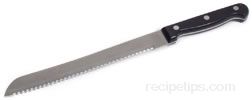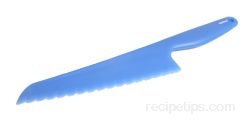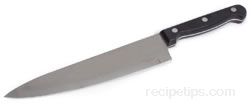



When selecting a knife the size and type desired is most often determined by the purpose of use. Since many knives are made for a specific purpose, such as chopping, mincing, cutting large items, or other tasks that are well defined, it is best to determine the use and then select one that fits the intended purpose. When selecting a knife, there are eight basic knife parts that are of value to understand which are: 1) tip, 2) cutting edge, 3) spine, 4) heel, 5) bolster, 6) tang, 7) butt, and 8) handle. The tip, which is the pointed end of the blade is most often used for spearing foods or cutting small items such as shallots, garlic, mushrooms, strips of foods, small shellfish, and other similar sized items. The cutting edge of the blade is the bottom side of the blade and it may be straight-edged or serrated, depending on the use. The top side of the blade, opposite the cutting edge is the spine, which is typically wider in width than the cutting edge and is blunt-edged so a thumb can rest on the surface of the spine when cutting foods. The heel of the blade is the cutting edge of the blade furthest away from the tip and it ends just before curving up into the handle. This area is most often used for heavier cutting tasks requiring downward pressure and coarser cuts. The knife bolster is the section that widens as it begins to curve upward toward the handle and extends to the top of the blade. The bolster is one part of the knife made to provide "balance" to the knife so that it handles well when cutting foods. The tang of a knife is the section that is built for the handles to be attached. If the knife is of higher quality, the tang begins at the bolster and extends to the rear or butt of the knife rather than stopping short of the butt. The tang is another section made so the weight and structure provides excellent balance for the knife handling. The tang will often have several holes where rivets enter to secure the handles on both sides of the tang. The knife butt is the end opposite the knife tip and on higher quality knives it is the point where the tang ends. The butt is often used as a meat tenderizer or a means to grind ingredients by some chefs, so stability and firm handling is a necessity. The handle, which is attached to the tang, may be made with any of a variety of materials such as wood, bone, plastic, metal, or a wood-plastic composite. It is then formed into a shape that provides a good grip and adds to the balance of the utensil.
Knife blades, which are made from steel, may be stamped or forged metal. Knives that are stamped are cut from a sheet of steel and then machined to form a taper ground blade, which is one that decreases in size from the handle to the tip and from the top (spine) to the bottom or cutting edge of the blade. If the knife were not machine tapered, the blade would be considered to be a constant or uniform thickness blade, which is not very functional hand cutting. Fully forged knives made from forged carbon or high-grade carbon stainless steel are of higher quality and provide better cutting and slicing performance.
The newest material used in making knife blades is zirconium oxide, also referred to as ceramic zirconia, a very hard substance that is only slightly softer than the hardness of diamonds. With a high degree of hardness, knives made from industrial ceramic do not easily dull and will maintain an exceptionally sharp edge before sharpening is required. Ceramic knives are excellent for slicing through a variety of foods, making thin slices an easy task. However, use on harder materials, such as bones and hard textured foods may result in chipped or broken blades, due to the hard and rigid blade materials that are not as flexible as more common metals. Ceramic knives will not need sharpening as often as other metal knives, but will require that the person doing the sharpening to be qualified for sharpening ceramic materials.
A knife blade may also be a hollow-ground blade that is manufactured with a process that fuses two separate pieces of metal together. After the pieces are fused, a beveled blade edge is created. This process is undertaken in order to provide a higher quality blade that provides exceptional cutting results.
Knives should be kept safely stored away from children and in clean dry areas that protect the blade from being easily damaged by other utensils, surfaces or moisture. Sharpen knives when necessary to insure effective performance. When sharpening knives, use processes that do not overheat the blade material, causing the temper of the blade to be damaged and no longer hold an edge. Hand sharpening with a whetstone or grinding lightly with a mechanized sharpener are best to keep blades sharp and well edged.